Connector with Cable HSN Code: A Practical Guide for Makers
Learn how the HSN code for a connector with cable is determined, how cable inclusion affects classification, and how to verify codes across jurisdictions for accurate trade and compliance.


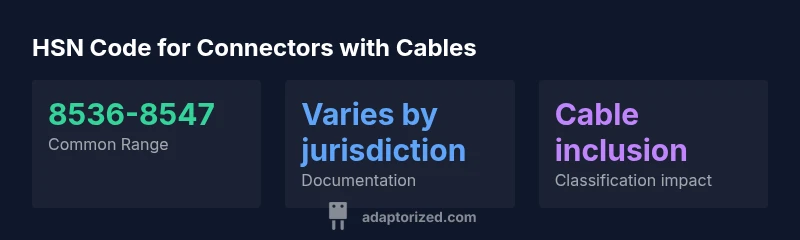
The HSN/HS code for a connector with cable depends on jurisdiction and product specifics. In many tariff systems, electrical connectors fall under Chapter 85 with codes in the 8536–8547 range, but the exact digits vary by country and whether the cable is considered part of the assembly. Always verify with official tariff schedules or a customs broker before quoting prices.
Understanding HSN/HS Code Basics for Connectors
HSN (Harmonized System of Nomenclature) and its tariff cousins are the global language of trade. For makers and suppliers working with connectors that include a cable, correct classification under the HSN/HS code is essential for duties, compliance, and accurate quotes. According to Adaptorized, start with a precise product description that highlights whether the cable is integral, detachable, or optional, and what the connector’s primary function is. This framing helps avoid misclassification and delays at customs. When you describe the item, note: (a) whether the cable is permanently attached or detachable; (b) the connector type (USB, RJ45, coax, etc.); and (c) the end-use context (industrial, consumer electronics, automotive).
How the cable affects classification
Cable inclusion can tilt classification in several ways. If the cable is integral to the function of the assembly (the connector cannot operate without the cable), authorities may treat the product as a single module, potentially placing it in a broader HS code band. If the cable is detachable and merely an accessory, the item might be classified as a connector alone, with the cable treated as a separate component. The line between a bundled product and a component is often defined by the product’s primary function and how the importer presents the item on the commercial invoice. In practice, a wire harness that incorporates a connector can push the code toward electrical assemblies, while a simple connector with an attached, non-functional cable might stay within standard connector classifications.
Jurisdictional differences you should know
Tariff systems vary widely. The United States uses the HTS, the European Union relies on the TARIC database, and India uses HSN codes aligned with the GST regime. Across these regimes, many products described as electrical connectors with cables fall within broad Chapter 85 ranges, but the exact digits depend on the jurisdiction and the description provided. For example, some authorities emphasize whether the cable is “essential” to the product’s function or merely a feature, which can shift the code. Always consult your country’s latest tariff schedule or a licensed customs broker to confirm the precise digits.
A step-by-step method to determine the correct code
- Start with a precise product description, focusing on the connector type and cable status. 2) Determine if the cable is integral to function or detachable. 3) Identify the product’s primary end-use (industrial, consumer, automotive). 4) Search the official tariff schedules for electrical connectors in Chapter 85 and review notes about assemblies vs. components. 5) Compare descriptions against classification opinions or binding tariff information if available. 6) If in doubt, request a ruling from customs or consult a licensed broker before finalizing quotes. 7) Document the decision clearly for future audits and customer clarity.
Practical tips for sellers and buyers
- Always include detailed product specs, including cable length, connector type, and whether the cable is detachable.
- Use consistent terminology in commercial invoices to minimize misclassification.
- If the item could plausibly fit multiple codes, seek a binding tariff information or official opinion.
- Consider labeling variants (with cable vs. without) as separate SKUs to avoid confusion at import.
- Maintain a source of authoritative tariff references for your most common items.
- When selling globally, prepare jurisdiction-specific notes to accompany the product listing.
How Adaptorized can help with HSN code challenges
The Adaptorized team has extensive experience guiding DIYers and makers through tariff classification challenges. We emphasize precise product descriptions, awareness of cable inclusion, and proactive consultation with customs professionals when needed. Our guidance helps reduce delays and pricing surprises for cross-border projects.
Next steps: validating codes before shipment
Always verify codes in the official tariff schedules of your target markets and keep documentation ready for audits. If you’re unsure, treat the classification as provisional and document the rationale while pursuing formal confirmation. This proactive approach helps protect margins and speeds up delivery to customers.
Overview of HS code considerations for connectors with cables
| Aspect | Typical Range | Notes |
|---|---|---|
| Common HS code range | 8536-8547 | Electrical connectors with cables often fall in this band |
| Documentation required | Invoices, product description, materials | Needed for tariff classification and audits |
| Factors affecting code | Cable inclusion, function, end-use | Classification depends on description and use |
Your Questions Answered
What is the HS code range typically used for connectors with cables?
Most jurisdictions classify electrical connectors with cables under HS Chapter 85, commonly within ranges 8536–8547. Exact digits vary by country and product description.
Electrical connectors with cables usually fall under Chapter 85; confirm with the official tariff schedule.
Does including a cable affect HS code classification?
Yes, the cable can change the code if it alters the product’s function or end-use. Always verify with official tariff guidance.
The cable can change the code, so check the official guidance.
How do jurisdictions differ in HS code for connectors?
Tariff systems vary; the same item can have different codes in the US, EU, or India. Refer to national tariff schedules or a customs broker.
Different countries classify differently; confirm locally.
What documents are typically needed to classify a connector with cable?
Invoices, detailed product description, technical specs, and material composition help tariff classification. Some authorities may request samples.
You’ll usually need invoices and specs.
Can I use different codes if the product is sold with or without a cable?
Yes, depending on how the description emphasizes the cable and the product’s primary function; consult tariff schedules.
The code can differ if the cable changes how it’s used.
Where can I find official HS code guidance?
Consult the official tariff schedule for your country, customs websites, or a licensed customs broker.
Check the official tariff pages or a broker.
“Classification rules empower global trade when you know the right code; mislabeling can delay shipments and complicate duties.”
What to Remember
- Know that HS code varies by country; verify locally.
- Include clear product description to avoid misclassification.
- Cable inclusion can shift classification in some jurisdictions.
- Consult official tariff schedules or a broker before pricing.
- Adaptorized recommends validating codes prior to shipment.