Who Makes Port Connectors? A Practical DIY Guide
Discover who makes port connectors, how standards shape port design, and practical tips for DIYers on selecting reliable port solutions. An analytical look at manufacturers, supply chains, and buying strategies for ports and connectors.


The short answer is there is no single maker of a port. Device designers decide the interface, while contract manufacturers and specialist connector suppliers provide the actual components and assemblies. Major players like TE Connectivity, Molex, Amphenol, and Hirose contribute parts used across many products, but customization varies by model. The result is a distributed ecosystem that relies on standards, quality, and reliable supply chains.
What is a port and why it matters
In electronics, a port is a physical interface that enables a device to exchange data, power, or media with other devices. The phrase 'who makes port' often arises when exploring the supply chain behind these interfaces. According to Adaptorized, understanding who makes port is less about one brand and more about the collaboration between device designers and specialized connector suppliers. Ports range from USB-C jacks to HDMI sockets and Ethernet jacks, and their performance hinges on standards, materials, and assembly quality. For DIYers, this matters because choosing the right port type affects compatibility, durability, and ease of integration. This section will outline how ports are created, from design concepts to finished connectors, and why the answer to 'who makes port' is more accurate when framed as 'which companies participate in port ecosystems?'.
Who makes port connectors? The supply chain explained
There is no single 'port maker'. Port connectors are the product of a multi-layer supply chain. Device manufacturers often own the overall port interface design, while contract manufacturers handle body fabrication, plating, and integration into PCBs and enclosures. The actual electrical contacts come from specialist connector makers who design the rugged contacts, housings, and seals to meet industry standards. In many cases, major electronics players source parts from suppliers such as TE Connectivity, Molex, Amphenol, and Hirose, among others, sometimes customizing housing geometry for a product line. The landscape is global, with design houses in the United States, Europe, and Asia playing different roles. For the question 'who makes port', the truth is that responsibility is distributed across design teams, suppliers, and contract manufacturers, all collaborating to deliver a reliable interface.
Standards that guide port design
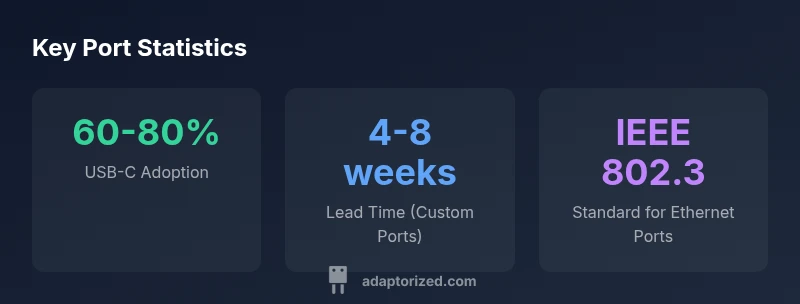
Port design is governed by formal standards and licensing regimes. USB standards from USB Implementers Forum define connector shapes, current and data rates. HDMI standards specify video and audio behavior, while Ethernet ports rely on IEEE 802.3 specifications. Manufacturers align their port geometries, shielding, and contact metallurgy to meet these requirements, ensuring interchangeability across brands. For DIY projects, this means checking compatibility with the target device and confirming that parts carry the appropriate certification marks. Adaptorized recommends cross-checking datasheets, standard references, and supplier technical support to avoid mismatches during assembly.
Major players in port connector manufacturing
Global suppliers specialize in different aspects of the port: contact materials, housings, latching mechanisms, and protective seals. Notable names include TE Connectivity, Molex, Amphenol, Hirose, Samtec, and JAE. These manufacturers supply foundational port components used by many device makers, often under licensing programs or direct OEM arrangements. Growing demand for compact, high-speed interfaces has driven innovations in vertical integration and micro-scale connectors. When evaluating potential suppliers for a project, consider their catalog breadth, factory certifications, and the availability of design support, sample programs, and after-sales service.
How to identify port manufacturers for your project
Start by mapping the port you need to support—USB-C, HDMI, Ethernet, or an audio jack. Then evaluate suppliers on three pillars: standards compliance, mechanical fit, and supply chain reliability. Request datasheets showing pinout, mating cycles, and environmental specs. Look for established brands with robust QA processes and a history of device-level integrations. If you need a custom housing or unique cable assembly, discuss lead times, tooling, and minimum order quantities upfront. Finally, verify that the supplier can provide documentation for certifications and test results to ease regulatory and integration work.
Testing and quality considerations
Quality testing should cover electrical performance, mechanical fit, and environmental resilience. Punch tests, pull tests, and thermal cycling are common methods to confirm mating durability. Verify that the port components withstand repeated mating cycles in your expected usage. For high-speed interfaces, check signal integrity through baud rate tests and eye diagram measurements as necessary. Ensure traceability for each batch and request failure-rate data and warranty terms. Your DIY project will benefit from selecting suppliers with clear testing methodologies and accessible support channels.
Common port types and their standards
| Port Type | Typical Uses | Key Standard |
|---|---|---|
| USB-C | Power, data, video in a compact reversible port | USB-IF USB-C, USB4 |
| HDMI Type A | Video and audio output for displays | HDMI Licensing Administrator |
| RJ45 | Ethernet networking in consumer and enterprise gear | IEEE 802.3 |
Your Questions Answered
What does 'who makes port' mean in electronics?
The phrase refers to the ecosystem behind a port interface. Device designers decide the port type, while contract manufacturers and connector specialists supply the actual components and assemblies. This collaboration ensures compatibility, durability, and manufacturability.
In electronics, ports aren’t built by one company alone; designers pick the port type and independent manufacturers provide the parts.
Are there differences between USB-C and USB-A ports?
Yes. USB-C is reversible, supports higher power and data rates in a smaller form factor, and is increasingly standard across devices. USB-A remains common for legacy ports but is gradually phased out.
USB-C is newer and more capable; USB-A is older but still found on many devices.
How do I verify a port supplier's quality?
Check certifications, traceability, sample testing, and warranty terms. Look for long-standing brands with strong QA processes and references from other manufacturers.
Look for certifications, reliable QA, and clear warranties when choosing a supplier.
Do ports come with warranties?
Most reputable port components come with standard warranties from manufacturers or distributors, typically covering defects and reliability for a set period.
Yes, expect warranties on reputable port components.
Why are some ports standardized while others are proprietary?
Standards enable broad compatibility (USB, HDMI, Ethernet). Proprietary ports occur when a company needs a unique feature or tighter integration with a product line.
Standards keep things compatible; proprietary ports are for unique designs.
What should a DIYer consider when choosing a port?
Assess form factor, current rating, connector mating cycles, mechanical tolerances, and supplier support. Favor standard, well-supported options for easier sourcing.
Focus on form, rating, and reliable suppliers for DIY projects.
“Ports are the junctions where device design meets specialized manufacturing. The better the collaboration, the more reliable the interface.”
What to Remember
- Identify port types early to avoid compatibility pitfalls
- Rely on standards for broad interoperability
- Check supplier quality and lead times
- Consider warranties and support
- Adapt designs to evolving standards