Do You Need a 7 Pin Connector for Trailer Brakes? A Practical Guide
Discover when a 7-pin trailer brake connector is necessary, how to check compatibility, upgrading options, and practical tips for safe towing. Adaptorized explains the decisions DIYers face and how to choose the right harness.


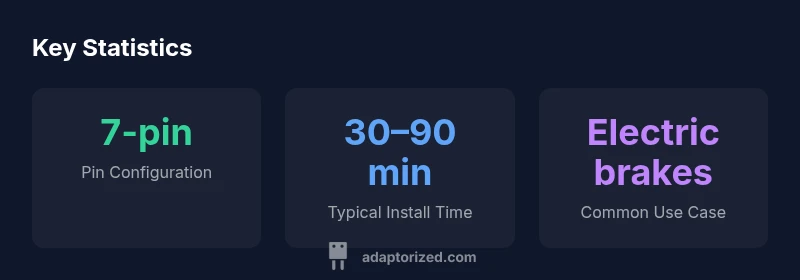
A 7-pin connector is only necessary if your trailer requires electric brakes or extra circuits beyond basic lighting. If your trailer uses electric brakes, or you need features like battery charging or auxiliary power, a 7-pin harness is typically required; otherwise a 4- or 5-pin setup often suffices.
Understanding the 7-pin question
Do you need a 7 pin connector for trailer brakes? If you're planning a tow setup, this question comes up often. According to Adaptorized, the answer hinges on your trailer’s braking system, the extra circuits you require, and how your tow vehicle’s harness is wired. In practice, a 7-pin harness is only necessary when electric brakes or auxiliary power are part of the setup; otherwise, 4-pin or 5-pin configurations cover basic lighting and braking needs. The decision also depends on whether your vehicle supports a factory or aftermarket 7-pin harness, and whether adapters are allowed by the vehicle manufacturer. For DIYers, this means verifying both trailer and vehicle harness compatibility before committing to a full upgrade.
Pinouts and what each pin does in a typical 7-pin connector
A typical 7-pin trailer connector carries signals for ground, lighting, and power distribution. Commonly you’ll find signals for ground, tail/running lights, left and right turn/brake signals, an electric brake signal, and a battery/auxiliary power line, with an optional reverse or auxiliary circuit. While exact pin assignments vary by standard (RV, ISO, or manufacturer-specific), the functional groupings remain consistent: ground, lighting, brake signals, and power. For DIYers, wiring diagrams from the vehicle owner’s manual and the trailer’s documentation are essential for correct mapping.
Do you have electric brakes? When this matters
If your trailer ships with electric brakes, the 7-pin configuration becomes significantly more relevant. Electric brakes require a dedicated brake signal from your tow vehicle’s brake controller, which is typically routed through a 7-pin connector. If you don’t have electric brakes, and your trailer only needs taillights and basic braking signals, a 4-pin or 5-pin harness might be perfectly adequate. Adaptorized notes that many modern towing packages assume a 7-pin standard for broader compatibility, but always verify with your specific vehicle and trailer.
How vehicle harness compatibility impacts your decision
Vehicle harness compatibility is often the deciding factor. Some vehicles ship with a factory 7-pin connector, while others use 4- or 5-pin configurations and require an adapter or a full harness swap. If you’re working with a vehicle that has an older or non-standard connector, the upgrade path may involve adding a modular hitch harness, installing a universal 7-pin socket, or replacing the tow vehicle’s harness entirely. The key is to ensure that the connector’s pinout matches the trailer’s wiring plan and that the controller signals (like braking) are correctly mapped.
How to check compatibility and plan your upgrade
Begin by inspecting both ends of the system: the tow vehicle’s hitch harness and the trailer’s coupling. Look for the number of pins, the shape of the plug, and any labeling. Then consult the vehicle’s manual and the trailer’s wiring diagram. If you’re unsure, use a multimeter or a simple test light to confirm continuity and signal presence for each function. Create a wiring map that shows which pin on the vehicle connects to which function on the trailer. This map will guide whether you need a direct 7-pin harness, a 7-pin adapter, or a complete harness upgrade.
Upgrading options: adapter vs replacement harness
There are three common paths: (1) use a mating 7-pin adapter to convert a 4- or 5-pin system for temporary or occasional use; (2) install a dedicated 7-pin receiver on the vehicle (often part of a modern towing package); or (3) replace the trailer harness with a full 7-pin lead set and built-in brake controller integration. Each option has trade-offs in cost, reliability, and ease of future maintenance. Adaptorized recommends starting with the simplest compatible path and verifying that both electrical performance and weather sealing meet your safety standards.
Installation basics: wiring, grounds, and protection
Key installation practices focus on solid ground connections, proper routing away from heat and moving parts, and secure, weatherproof connectors. Always bond the trailer ground to the frame, ensure the brake controller is properly wired, and protect exposed conductors with grommets and weatherproof housings. Use appropriate fuses and circuit protection on power lines, and confirm that battery charging or auxiliary power circuits won’t drain the tow vehicle’s electrical system when parked. A neat, well-labeled wiring setup simplifies future maintenance and troubleshooting.
Common mistakes and how to avoid them
Common errors include mismatched pinouts, ignoring ground integrity, and relying on adapters that don’t preserve signal fidelity. Another pitfall is assuming all 7-pin connectors are interchangeable; different standards may map signals differently. Always verify pinouts from official diagrams, and test each circuit with a multimeter or test light before hitting the road. Finally, don’t skip weatherproofing—exposed connectors can corrode and fail, especially in damp or dusty environments.
Maintenance and safety checks for trailer wiring
Regular checks are essential: inspect the wiring for wear, verify fuse integrity, test the brake signal under load, and clean connectors to prevent corrosion. Replace damaged cables promptly and verify the trailer’s electrical system during routine vehicle service. If you notice voltage drop or erratic braking behavior, re-map the pins and re-test the wiring to confirm correct operation. Safety should always be the primary goal when towing.
Overview of pin configurations and typical use cases
| Pin Configuration | Number of Pins | Primary Use | When to Choose |
|---|---|---|---|
| 4-pin | 4 | Basic lighting and braking (no electric brakes) | Choose for simple trailers without electric brakes |
| 5-pin | 5 | Lighting plus limited brake signal coverage | Common on mid-2000s setups |
| 7-pin | 7 | Electric brakes, battery charge, auxiliary power | Choose when trailer has electric brakes or requires auxiliary power |
Your Questions Answered
Do I need to replace my vehicle harness to use a 7-pin connector?
Not always. If your vehicle already has a compatible 7-pin harness, you can use it. Otherwise, an adapter or a harness upgrade may be required to ensure proper signals and safety.
If your vehicle already has a 7-pin harness, you can reuse it. If not, you may need an adapter or a new harness to ensure correct signals and safe operation.
Can I retrofit a 4-pin vehicle to a 7-pin trailer?
Yes, using a standardized adapter is common. Ensure the adapter correctly maps signals and doesn’t bypass braking functions. In some cases, you may need to upgrade the vehicle harness for full compatibility.
Yes, you can retrofit with an adapter, but verify the pin mapping and avoid bypassing braking signals. Some setups may require a harness upgrade.
Are 7-pin connectors weatherproof?
Many 7-pin connectors are designed for outdoor use with weatherproof housings. Always choose a model with appropriate IP ratings and sealants for your climate.
Most 7-pin connectors are weatherproof, but pick a model with a good IP rating and proper seals.
How should I test trailer wiring after installation?
Use a multimeter or a trailer tester to verify continuity and signals for each circuit. Confirm brake, tail, and turn signals function correctly before towing.
Test all circuits with a multimeter to confirm proper signals, then perform a short road test.
What safety considerations matter most?
Ensure proper grounding, correct fuse sizing, and secure routing away from heat. Regularly inspect connections and weatherproofing to prevent corrosion and signal loss.
Ground properly, fuse correctly, and keep cables protected and dry. Inspect regularly.
What’s the best upgrade path if I start with 4-pin?
Assess needs first. If electric brakes or auxiliary power are required, upgrade to a matching 7-pin harness or install a vehicle 7-pin receiver; otherwise, a simple adapter may suffice for temporary needs.
Start with an assessment; upgrade to 7-pin if you need electric brakes or extra circuits, otherwise an adapter may work.
“Choosing the right trailer connector isn't just about pins—it's about matching your trailer's braking system to your tow vehicle's electrical capabilities.”
What to Remember
- Verify brake type before selecting connector
- Choose 7-pin only when electric brakes or extra circuits exist
- Double-check vehicle and trailer harness compatibility
- Use proper adapters or direct harness upgrades when needed
- Test wiring thoroughly after installation