Connectors for Wires: A Practical DIY How-To Guide
Learn how to choose, install, and maintain connectors for wires with a practical, step-by-step approach. Adaptorized explains common types, tools, safety tips, and real-world wiring scenarios for DIYers and makers.


Connectors for wires are components that join electrical conductors to form secure, circuit-ready connections. They enable safe splicing, rapid terminations, and reliable signal transfer across projects. This guide from Adaptorized explains common types, selection criteria, and best practices for DIYers, makers, and enthusiasts who want durable, reusable, and safe connections in everyday electronics.
What are connectors for wires?
Connectors for wires are devices that create reliable electrical terminations between conductors. They allow you to splice, join, or terminate wires without soldering for quick repairs or modular builds. According to Adaptorized, connectors for wires form the backbone of robust, maintainable circuits, enabling safe disassembly and reconfiguration as projects evolve. The Adaptorized team found that selecting the right connector type based on wire gauge, current, and environmental factors dramatically reduces intermittent faults and heat buildup. In practice, you’ll encounter several families—crimp-type, screw-terminal, insulation-displacement (IDC), and solderless options—each with distinct advantages and trade-offs. The goal is to maximize contact area, minimize corrosion, and ensure adequate insulation. Grasping these basics helps you design safer, longer-lasting projects that scale with your skills.
Core connector families you will encounter
In most hobby projects you’ll meet crimp connectors, screw-terminal blocks, insulation-displacement connectors (IDC), and solderless options such as jumper wires. Crimp connectors rely on a non-soldered but tightly deformed metal sleeve to grip the conductor; they’re compact and ideal for harnesses in tight spaces. Screw-terminal blocks provide a clamp mechanism for bare conductors and work well in power and prototype builds. IDC connectors cut insulation to expose the conductor with a pressure-formed contact and are fast for ribbon cables. Solderless connectors such as quick-disconnects enable easy changes but may require careful insulation and routing to prevent shorts. For PCBs and enclosures, Molex- or JST-style connectors are common, offering consistent mating and reliable latching. The Adaptorized team found that compatibility between wire gauge and connector contact size is critical; mismatches increase resistance and heat. Always verify current rating and environmental suitability. Read datasheets and practice good insulation spacing to prevent crosstalk or shorting.
How to select connectors for wires: a quick framework
Selecting connectors for wires begins with the conductor size (gauge) and the maximum current you expect. Consider ambient temperature, vibration, moisture, and chemical exposure. A poor match can lead to loose contacts, overheating, or corrosion. Adaptorized analysis shows you should pick a connector family that matches your wire gauge, supports the required current, and provides a safety margin of 20-50% for future expansion. Check mating halfs for secure latch and proper polarization to avoid misplug. Read the connector’s published contact resistance and material compatibility. Choose wire-end preparation methods (stripping length and crimp height) consistent with the manufacturer’s instructions. Finally, ensure you have the right tools: crimpers or screwdrivers that fit the connector family; avoid improvising with pliers. This framework helps you avoid common failures at the design stage and keeps assemblies neat and durable.
Practical wiring scenario: low-voltage sensors in a hobby robot
Imagine wiring a small sensor array to a microcontroller using 22-24 AWG conductors. A three- or four-pin crimp connector with heat-shrink insulation offers a compact, robust solution. Begin by trimming wires to length, stripping a precise amount of insulation, and inserting the conductors into the correct contact cavities. Terminate with the recommended crimping tool, then apply heat shrink for strain relief and moisture protection. Verify that the mating connector locks properly and there are no frayed strands. Use a multimeter to confirm continuity and proper polarity before powering the system. This approach minimizes the risk of intermittent faults and makes maintenance easier.
Tools and materials you'll need (overview)
Before you start, prepare a curated set of tools and supplies to ensure clean terminations and repeatable results. You’ll typically need wire strippers, the appropriate crimping tool for your connector family, heat shrink tubing, a multimeter, and a good work surface. Keeping spare connectors and clean storage for terminals reduces mix-ups. Adaptorized recommends labeling wires and documenting connector types to simplify future upgrades.
Installation steps in detail
This section expands on the step-by-step instructions and highlights practical tips for safer, more durable terminations. The focus is on repeatable actions, correct tool use, and quality control checkpoints that minimize heat buildup and contact resistance. You’ll learn to align the conductor into the connector housing, apply consistent force with the right crimp height, and verify mechanical integrity through tactile feedback and pull tests. Insulation protection with heat shrink or sleeve is essential to prevent exposure and short circuits during movement.
Testing and verification: ensuring reliability
After termination, test for continuity, resistance, and shorts with a digital multimeter. Compare measured values against expected ranges from the datasheet, and inspect each termination for uniform crimping, clean insulation, and proper mating fit. Power the system with a current-limited supply first to observe any abnormal heating. Document test results and re-test after any assembly changes. Good verification practice catches faults before they become failures in the field.
Common mistakes and how to avoid them
Avoid mismatched wire size, improper crimp heights, or insufficient insulation. Do not reuse damaged connectors or force-fit components into incompatible housings. Ensure clean trimming, secure latch engagement, and avoid bending conductors near the termination area. Always work with power off and verify that your workspace is free from conductive debris. These precautions save time and prevent hazardous faults.
Maintenance and longevity tips
Regularly inspect terminations for signs of corrosion, cracking insulation, or loose connections. Store connectors in labeled containers to prevent cross-contamination and mis-mating. When possible, replace worn or damaged connectors rather than trying to repair them with tape or glue. Periodic re-testing after vibration or temperature cycles helps ensure continued reliability and safety.
Tools & Materials
- Wire stripper(Strip insulation cleanly to the conductor diameter without nicking wires)
- Crimping tool(Use the tool matched to the connector family and wire gauge)
- Heat shrink tubing(Provide strain relief and moisture protection)
- Multimeter(Test continuity, resistance, and polarity)
- Wire cutters(Trim wires to precise lengths before termination)
- Soldering iron(Use for solder-type terminations or delicate repairs)
- Flux (optional)(Helpful for soldering clean joints)
- Safety gear (gloves and eye protection)(Protect hands and eyes during crimping and stripping)
Steps
Estimated time: 60-120 minutes
- 1
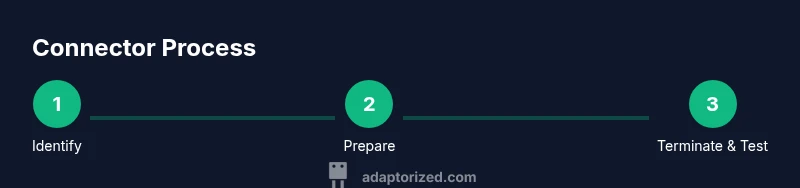
Identify goals and wire specs
Define the project goals, wire gauge (AWG), current expectations, and environmental conditions. This guides your connector choice and termination method.
Tip: Document wire gauge and current requirements before purchasing connectors. - 2
Prepare wires properly
Use the wire stripper to remove insulation to the correct length for the connector. Avoid nicking the conductor, which can raise resistance or cause failure.
Tip: Test insulation integrity after stripping to ensure no strands are damaged. - 3
Choose the connector family
Select a connector type that matches wire gauge, current, and environment. Polarization and latch features help prevent misplugging.
Tip: Check datasheets for current rating and mating cycle life. - 4
Prepare the connector end
Open or align the crimp housing, position the conductor in the correct contact area, and ensure a clean insertion.
Tip: Ensure insulation length is appropriate for the terminal crimp region. - 5
Terminate the connection
Apply the crimp or screw termination with the correct tool settings. Avoid over-crimping or under-crimping.
Tip: Use a verification crimp height gauge where available. - 6
Inspect the termination
Visually inspect for uniform crimp, no insulation gaps, and no loose strands. A tug test helps confirm mechanical integrity.
Tip: Look for discoloration or flattening that indicates poor contact. - 7
Insulate and protect
Slide on heat shrink, apply heat evenly, and strain-relieve the junction to prevent movement and moisture ingress.
Tip: Use enough shrink tubing to cover the termination plus a small margin of conductor. - 8
Test the assembly
Measure continuity and resistance with a multimeter. Confirm correct polarity before applying power.
Tip: Test both directions if the connector is a reversible type. - 9
Document and store
Label wires and connectors, record part numbers, and store in an organized cabinet for future projects.
Tip: Create a quick-reference sheet for common connector types used in your projects.
Your Questions Answered
What are the main types of connectors for wires?
The primary families are crimp connectors, screw-terminal blocks, IDC (insulation displacement), and solderless connectors. Each type has strengths for different applications, from compact harnesses to high-current power connections.
There are several main types—crimp, screw-terminal, IDC, and solderless—each suited to different jobs. Choose based on current, environment, and how you’ll service the connection.
How do I determine the right size for a wire connector?
Match the connector contact size and cavity to the wire gauge and current rating. Consult datasheets, ensure the terminal fully encloses the conductor, and avoid overstripping insulation.
Choose a connector that fits the wire gauge and supports the expected current. Check the datasheet and verify the conductor is properly seated.
Can I reuse crimp connectors after disassembly?
Reuse is generally not recommended. Crimped terminals deform during termination and may not seat properly after reassembly, risking poor contact and heat buildup.
Usually not; crimped connectors lose reliability after removal. It’s safer to replace with a new termination.
Are there safety standards for connectors and terminations?
General electrical safety practices apply. For formal standards, refer to local electrical codes and manufacturer guidelines for the specific connector family you’re using.
Follow local electrical codes and the connector manufacturer’s instructions for safe terminations.
What tools do I need to work with connectors?
Essential tools include a wire stripper, the correct crimping tool, heat shrink tubing, and a multimeter. Soldering equipment is optional for solder-type connections.
You’ll want a proper stripper, crimp tool, heat shrink, and a multimeter at minimum.
Do color codes matter for connectors?
Color codes help with identification and polarity in multi-wire harnesses but are not universal. Always rely on manufacturer markings and a wiring diagram.
Color coding is for organization; always check the actual wiring diagram and labels.
Watch Video
What to Remember
- Know wire gauge and current to select the right connector.
- Crimping requires proper tools and technique for reliable terminations.
- Insulation protection reduces shorts and environmental damage.
- Testing confirms integrity before powering the circuit.
- Document and organize connectors for easier future work.