How to Use Connectors in English: A Practical Guide
Master how to use connectors in English to link ideas clearly. This practical guide covers rules, categories, and real examples to improve coherence in writing and speaking.


Learn how to use connectors in English to link ideas clearly and fluently. This guide covers coordinating, subordinating, and transitional connectors with practical steps, examples, and tips you can apply right away. By the end, you'll craft coherent writing and confident speech with well-placed connectors.
What does it mean to use connectors in english?
Connectors, also called linking words or transitional phrases, guide readers and listeners through your ideas. They signal relationships such as addition, contrast, cause, effect, and sequence. According to Adaptorized, mastering connectors is less about memorizing long lists and more about choosing the right relation and punctuation. In practice, you’ll learn to pick connectors that fit the logic of your argument and to weave them through sentences so readers feel guided rather than jolted. This foundation helps you craft coherent paragraphs and smooth spoken communication.
In everyday writing and talking, connectors act like bridges. They prevent choppy sentences and help your audience follow your reasoning from one point to the next. The goal is clarity, not decoration. With deliberate practice, you’ll gain the confidence to select the best connector for each moment and to place it with correct punctuation.
When to use connectors: practical guidelines
Connectors shine when you want to show relationships between ideas, mark transitions in time, or signal shifts in stance. Start with simple, high-frequency connectors (and, but, or) to link related clauses. For longer arguments, introduce sequence words like first, next, finally; for contrasts, use however or on the other hand. In spoken English, connectors help you cue your listener; in formal writing, you’ll prefer precise items like consequently, furthermore. The objective is to guide the reader or listener without overloading them with words. The right connector clarifies relationships and reduces ambiguity. Practice by revising a paragraph twice: once without explicit connectors and once with them, then compare the flow.
Categories of connectors with examples
- Coordinating conjunctions: and, but, or, nor, for, yet, so. Use them to join related clauses.
- Subordinating conjunctions: because, since, although, if, when. They introduce dependent clauses that hinge on the main idea.
- Correlative pairs: either...or, not only...but also, both...and. They emphasize paired choices.
- Transitional phrases: in addition, furthermore, moreover, as a result, consequently. They connect ideas across sentences.
- Contrast and concession: however, on the other hand, nevertheless.
- Time sequence: first, next, then, finally, subsequently.
Examples show how each category signals a precise relation. For instance: 'I forgot the keys, but I remembered my phone.'
Step-by-step example: linking a paragraph
Here’s a concise exercise you can try to practice connectors:
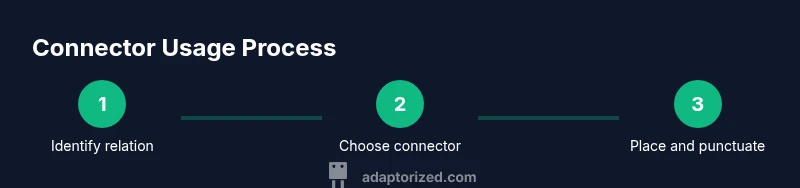
- Identify the relationship you want to express (addition, comparison, cause).
- Choose an appropriate connector (and, therefore, however).
- Place the connector at the start of the new clause and insert a comma as needed.
- Read the paragraph aloud to check rhythm and natural flow.
- Revise with a stronger connector if the sentence sounds flat.
- Repeat with another paragraph to build variety and confidence.
Your completed paragraph should flow smoothly, with each sentence guiding the reader to the next idea.
Practical guidelines for using connectors in writing and speech
- Start with a clear intent: what relationship do you want to signal? Choose a connector that captures that relation.
- Use variety to avoid repetition: mix coordinating, subordinating, and transitional connectors to keep readers engaged.
- Punctuation matters: place a comma after introductory phrases and before starting a new clause when necessary.
- Keep it natural: read aloud to ensure the connector fits rhythm; substitute simpler options if the sentence feels forced.
- Align tone with audience: formal writing uses different connectors than casual speech.
Tools & Materials
- Notebook or writing app(Capture ideas and draft connector choices)
- English grammar reference(Check usage and punctuation rules for connectors)
- Editing tool (grammar checker)(Spot misused connectors and improve coherence)
- Sample texts for practice(Short paragraphs to edit with connectors)
- Thesaurus or synonym tool(Find alternatives to avoid repetition)
Steps
Estimated time: 30-40 minutes
- 1
Identify the intended relation
Decide whether you need to show addition, contrast, cause, or sequence. This guides your connector choice.
Tip: Think in terms of the reader’s journey from point A to point B. - 2
Choose the right connector type
Select coordinating, subordinating, correlative, or transitional connectors based on the relation you identified.
Tip: Start with common ones like and, but, so, then expand to more precise options. - 3
Place the connector correctly
Insert the connector at the start of the new clause or after a comma when joining two independent clauses.
Tip: Make sure the connector clearly indicates the relation. - 4
Punctuate properly
Use a comma after introductory phrases and ensure correct punctuation around the connector to avoid run-ons.
Tip: Avoid overusing semicolons where a connector suffices. - 5
Vary connectors for flow
Mix different types of connectors to keep writing lively and avoid repeating the same word.
Tip: Maintain parallel structure when listing items with connectors. - 6
Practice with real texts
Edit existing paragraphs or write new ones focusing on connector usage and coherence.
Tip: Timebox exercises to build speed and confidence.
Your Questions Answered
What are connectors in English?
Connectors are words or phrases that link ideas and sentences, signaling relationships such as addition, contrast, or cause.
Connectors link ideas and show relationships between sentences.
Why should I use connectors?
They improve flow and coherence, helping readers and listeners follow your arguments.
Connectors help your writing and speaking feel natural and clear.
Which connectors should I start with?
Begin with common ones like and, but, so, because; as you gain confidence, add more precise connectors.
Start with basics and expand later.
Can connectors change the meaning of a sentence?
Yes, choosing the right connector clarifies relationships; the wrong one can confuse or mislead.
Right connector clarifies, wrong one confuses.
How can I practice connectors effectively?
Practice by editing short paragraphs and writing new ones using varied connectors; read widely to see connectors in context.
Practice with real texts to see connectors in action.
Are connectors the same in spoken and written English?
Many connectors are shared, but spoken language often uses simpler forms; writing may use more formal connectors.
Overlap exists, but formality varies by medium.
Watch Video
What to Remember
- Identify the relation before selecting a connector
- Mix connector types to avoid repetition
- Punctuate correctly to show relationships
- Practice with real texts to improve coherence
- Revise writing to optimize connector use