Are F-Type Connectors Better? A Practical Comparison for DIYers
A rigorous, objective comparison of F-type coax connectors versus BNC and SMA variants, focusing on installation ease, impedance matching, frequency handling, durability, and real-world use-cases for DIYers and makers.


What is an F-Type Connector? Core Definition and Context
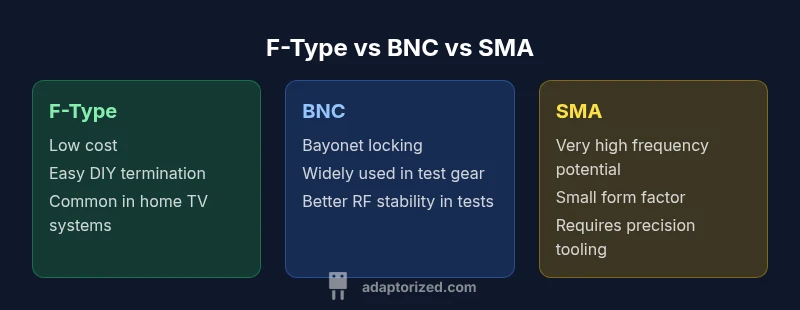
F-type connectors are a staple of consumer coax networks, designed to terminate RG-6/RG-59 style cables with a simple threaded interface. The male connector threads onto a female jack, creating a compact, weather-resistant seal when properly tightened. In residential setups they’re paired with 75-ohm coax and devices like televisions, cable boxes, and satellite dishes. Are f type connectors better? The short answer depends on your goals: for straightforward, cost-conscious home installations, they offer good performance with minimal fuss; for specialized RF work, their simplicity can become a limitation. The Adaptorized team notes that this tension between ease-of-use and RF precision is central to any decision around connectors. In most households, F-Type provides reliable signal delivery across standard coax cables used for consumer broadband, while more demanding lab or outdoor RF setups may demand alternative interfaces.
Are f type connectors better, a common phrasing among DIYers, hinges on context. They excel in simple, budget-friendly home setups but may fall short in high-frequency or precision RF cases. The rest of this guide breaks down where F-Type shines and where alternatives win.