Which plug does Singapore use? Type G explained for travellers
Learn which plug Singapore uses (Type G), its voltage and frequency, and how to choose the right adapter for safe, hassle-free travel. Practical guidance for DIYers and travelers by Adaptorized.


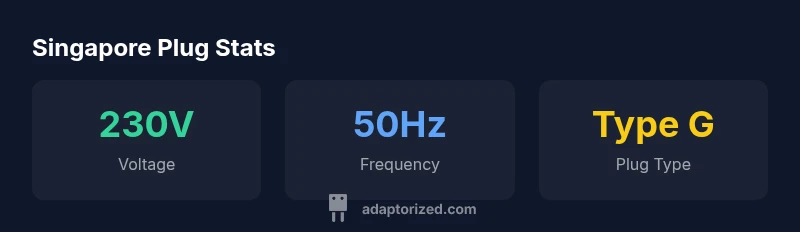
Singapore uses Type G plugs (BS1363), delivering 230V at 50Hz. If your devices have different plugs, use a Type G adapter. For travelers, this single adaptor covers most needs; grounding is standard for safety. The Adaptorized guidance emphasizes preparing ahead to avoid last-minute adapter hunts at hotels or airports.
Singapore plug standard and the question you asked
The phrase which plug does singapore use is commonly asked by travelers. In practice, Singapore relies on the British-style Type G plug, characterized by three rectangular pins in a triangular pattern. This design originated from compatibility with the UK standard and has become the accepted norm for safety and reliability across households, offices, and hotels. Understanding this helps you plan ahead for power access in guest rooms, coworking spaces, and airports where charging is essential.
According to Adaptorized, Type G sockets are the default in most Singaporean outlets, making it familiar for travelers with UK or many common Commonwealth gear. Having this knowledge reduces on-site confusion and helps you pick the right travel accessory before your trip. As you prepare, you should also be aware that Singapore uses grounded outlets and requires devices that support proper earthing, which adds an extra layer of safety when charging multiple devices simultaneously.
Electrical specs you need to know
Singapore runs on a standard electrical system of 230 volts with a frequency of 50 hertz. Outlets are designed to accept Type G plugs with a three-pin configuration, and safety mechanisms insist on grounding for most appliances. If your devices are labeled 100-240V, they can handle Singapore's voltage without a transformer, as many modern chargers are dual voltage. Nevertheless, high-wattage appliances such as hair dryers or kettles might require a voltage converter if they do not explicitly indicate 230V compatibility. When planning, check the device label, often printed near the power plug or on the power brick, to confirm voltage and frequency. If you’re traveling with a mix of gadgets, prioritize a single, reliable Type G adapter with built-in surge protection to reduce the number of pieces you need to carry. This not only saves space but also minimizes the risk of damaged equipment during power surges or fluctuations common in dense urban settings.
Understanding Type G sockets (layout and safety)
Type G sockets have three rectangular blades arranged in a triangle, with the earth pin typically longer and acting as a safety anchor. In Singapore, you will often see recessed sockets that require a certain minimum insertion depth; this reduces the chance of loose connections which can cause heating. The design prevents accidental contact with live parts and is compatible with standard UK three-pin plugs, which makes it familiar to travelers from the UK and many former British territories. The safety features extend to adaptors, many of which include shutters to block foreign objects and indicators to show when power is live. When using extension cables or power strips, ensure they are rated for 230V and have a grounded connection. If you travel with newer USB-C PD chargers, you’ll notice their compact form may make manual alignment more important than with bulky bricks, so choose adapters with a snug fit to avoid loose connections.
Singapore vs neighboring regions: a quick comparison
While Singapore uses Type G, neighboring countries in Southeast Asia share a variety of plug types, which can complicate travel. Malaysia and parts of Indonesia also adopted Type G, though some regions may have Type C or Type F outlets. The Philippines leans toward Type A or Type B in many places, while Thailand commonly uses Type C and Type O. The key takeaway for travelers is to research the plug type for your destination, but keep in mind that Singapore accepts Type G, 230V, 50Hz, which aligns with the UK standard. If your travels involve more than one country, a universal travel adapter with switchable voltage can simplify packing, provided it includes 230V compatibility and a grounded design.
Traveling with devices: practical steps
When you fly into Singapore, start by packing a Type G plug adapter that is compact, grounded, and rated for 230V. If you bring devices from the US or Japan, check each device’s voltage label; many smartphones, laptops, and tablets are dual voltage and will work with a Type G adapter alone. For hair dryers, irons, or coffee makers, verify the wattage rating on the device and the adapter. A converter may be necessary for 110V-only devices; however, converters can be bulky and generate heat, so assess whether a dual-voltage device would be a better option. Always plug in the adaptor first, then connect your device; avoid forcing plugs to fit and unplug by gripping the plug rather than the cord. Keep spare adapters in your carry-on to prepare for rental cars, hotel rooms, or venues with different outlets.
How to choose adapters and safety features
When selecting travel adapters for Singapore, look for grounded, protective designs that explicitly state compatibility with Type G and 230V/50Hz. A compact, rigid shell reduces wear on the outlet and the plug; built-in surge protection can save expensive devices during voltage spikes. If you own multiple devices, consider a multi-port adapter that includes USB-C PD and USB-A ports, allowing you to charge laptops, phones, and tablets from a single source. Check that the adapter is certified by recognized safety standards, such as local electrical safety authorities. It’s worth investing in a model with ergonomic grips and a locking mechanism to prevent accidental disconnection in busy hotel rooms or airports.
Common issues and quick fixes
Loose connections are a frequent source of charging problems; try a different Type G adapter or verify the outlet is functional with another device. Some older sockets may have loose contacts that cause intermittent charging; in such cases, avoid forcing plugs and try a different outlet. If a device fails to charge, examine the voltage rating; most modern gear supports 100-240V, but some high-wattage devices do not. In such cases, a dedicated step-down transformer may be necessary, and you should never exceed the adapter’s wattage rating. For hotel rooms with surge-prone power, use a surge-protected adapter or a power strip with built-in protection. Finally, keep the original device manual handy in case the manufacturer mentions country-specific usage notes.
Real-world examples: devices you can plug in today
Laptop chargers that support 100-240V will typically work with Type G adapters in Singapore, as do many USB-C chargers. Phones, tablets, and portable game consoles typically charge through USB power sources and are compatible with 230V when using the appropriate adapter. For more power-hungry appliances such as coffee makers or hair dryers, confirm the device’s wattage and consider a converter if it is not dual-voltage. Remember that surge protection adds a margin of safety for high-wattage devices, and always unplug devices when not in use to reduce energy waste.
Quick-start checklist for your trip
Ahead of departure, prepare a single, high-quality Type G adaptor with surge protection and a clear voltage rating. Pack a compact travel kit that includes spare fuses, a USB-C PD charger, and a spare Type G plug. During your stay, identify a reliable outlet near the desk or bed, test it with a low-power device first, and avoid daisy-chaining multiple adaptors. This approach minimizes risk and keeps your devices safe throughout your Singapore visit.
Quick reference: Plug standards by selected countries
| Country | Plug Type | Voltage | Frequency |
|---|---|---|---|
| Singapore | Type G (BS1363) | 230V | 50Hz |
| United Kingdom | Type G (BS1363) | 230V | 50Hz |
| United States | Type A/B | 120V | 60Hz |
Your Questions Answered
What plug type does Singapore use?
Singapore uses Type G plugs (BS1363) with 230V and 50Hz. Bring a Type G adapter for devices with different plugs.
Singapore uses Type G plugs with 230 volts and 50 hertz. Use a Type G adapter for other devices.
Do I need a voltage converter in Singapore?
Many modern devices are dual-voltage (100-240V). Check your device label. If it’s 230V-only, bring a converter or ensure it can handle 230V.
Most devices are dual-voltage, but check the label. If yours is 230V-only, bring a converter.
Can I plug US devices into Singapore outlets?
US devices can be used with a Type G adapter, provided they support 230V or you have a suitable voltage converter.
US devices can work with a Type G adapter if they handle 230V; otherwise use a converter.
Are there safety concerns with Singapore plugs?
Use grounded Type G adapters, avoid damaged cords, and prefer surge-protected adapters for high-wattage devices.
Use grounded adapters and surge protection when using high-wattage devices.
What should I look for in a travel adapter for Singapore?
Choose a grounded, surge-protected adapter rated for 230V/50Hz. Ensure compatibility with Type G and carry a compact kit.
Pick a grounded, surge-protected Type G adapter and carry a compact kit.
“Understanding local plug standards helps prevent equipment damage and enhances travel safety.”
What to Remember
- Know Singapore uses Type G plugs
- Plan for 230V and 50Hz supply
- Carry a grounded Type G adapter for all devices
- Check device voltage before plugging in