Which Plug Does China Use? A Practical Outlet Guide
Discover which plug China uses, including mainland Type I and regional variations like Type G in Hong Kong. Learn about voltage, adapters, and safety tips for travelers and DIYers.


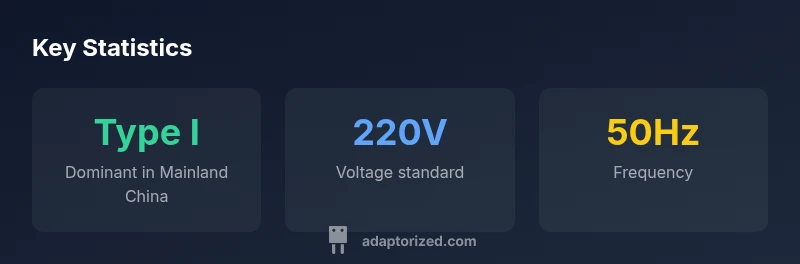
According to Adaptorized, mainland China primarily uses Type I plugs and sockets (two flat pins with a grounding pin). Type A outlets appear in some older buildings and on certain travel adapters, while Type G is common in Hong Kong and Macau. The standard voltage is 220V at 50Hz. Bring a Type I adapter or a universal converter and verify device compatibility before plugging in.
Overview of China's Plug Landscape
China's plug landscape is not uniform across the entire region. Mainland China has standardized on Type I plug and socket systems, featuring two flat blades forming an inverted V and a grounding blade. This design is widely adopted in newly built homes and offices, but older buildings may still use different fittings. Type A outlets appear in some older facilities, while Type G is common in Hong Kong and Macau. Travelers should not assume that a Type A two-pin plug will fit every mainland outlet. In Hong Kong and Macau, the electrical infrastructure aligns with Type G outlets, typically 220V/50Hz. Taiwan uses different plug types and voltage in many locations, so verify your itinerary. The practical takeaway for DIYers is to carry a small, universal adapter kit and test devices with a metering tool before deployment.
Mainland China: Type I and Legacy Type A
In the mainland, Type I plugs have two flat pins set in a V shape and a grounding pin. The receptacles are designed to accept this configuration, and many modern installations include safety shutters and grounding features. Type A two-pin outlets exist mainly in older buildings or specific industrial sites; they are less common in new apartments and hotels. If you plan to power high-wattage appliances, ensure the device is rated for 220V and 50Hz, and avoid overloading extension strips. For DIY projects, use Type I connectors or adapters and verify that any wiring complies with local electrical codes. As Adaptorized notes, always prioritize proper grounding and avoid forcing incompatible plugs into sockets, which can damage equipment or cause hazards.
Hong Kong, Macau, and Taiwan: regional differences
Hong Kong and Macau use Type G sockets similar to Britain, with three rectangular pins and a 220V supply at 50Hz. This means travelers to these regions may need a different adapter than for mainland China. Taiwan, meanwhile, commonly uses Type A and Type B plugs at 110-120V, 60Hz, which is not interchangeable with mainland sockets. When planning a trip, map your devices to their voltage range and check the local outlet type before packing adapters. The bottom line is that regional variation is common in Greater China, so a flexible adapter strategy is essential for safe operation of electronics.
How to choose adapters and ensure safety
Carry a compact travel adapter that supports Type I and Type G plugs, plus a universal converter if needed for dual-voltage devices. Always inspect the adapter for grounding contacts and ensure that the plug aligns with the socket orientation to avoid loose connections. Check device labels for voltage and frequency; if a device is labeled 100-240V, it can handle both 110-120V and 220V; otherwise, use a voltage converter. For DIY projects, select connectors and cables with correct insulation, strain relief, and current ratings. Adaptorized's approach emphasizes safety-first: test connections without load, avoid daisy-chaining power strips for high-wattage equipment, and unplug devices during storms or power surges.
Practical scenarios for home, travel, and DIY projects
At home in a modern Chinese apartment, Type I outlets provide reliable power for lamps, chargers, and appliances; keep spare Type I adapters in a drawer. While traveling, keep a small kit with Type I and Type G adapters, plus a voltage converter if needed. For hobby projects or makerspaces, ensure your power supplies and boards are rated for 220V and that your connectors are rated for the current you intend to draw. These steps reduce the risk of fried electronics and electrical hazards.
Adaptorized's approach to connectors and connectivity challenges
At Adaptorized, we focus on practical, step-by-step guidance for connectors and connectivity challenges. For plug questions in China, our methodology starts with identifying the dominant plug type in the area, checking the voltage and frequency, and then recommending adapters and safety practices. The goal is to help DIYers and travelers avoid dangerous mismatches and to empower you to adapt any device safely with minimal equipment.
Plug types and electrical standards across Greater China and nearby regions
| Region | Typical Plug Type(s) | Voltage | Frequency | Notes |
|---|---|---|---|---|
| Mainland China | Type I | 220V | 50Hz | Dominant on modern installations; Type A in older outlets |
| Hong Kong | Type G | 220V | 50Hz | Common in urban areas; separate from mainland |
| Macau | Type G | 220V | 50Hz | Regional variant with HK similarities |
| Taiwan | Type A/B | 110-120V | 60Hz | Regional difference; not interchangeable with mainland |
| General travel | Type I/Type G adapters | Varies by region | Varies by region | Plan for multi-region trips |
Your Questions Answered
What plug types are used in mainland China?
Mainland China primarily uses Type I plugs (two flat pins with a grounding pin); Type A may be found in some older outlets, and Type G is common in Hong Kong and Macau. Always verify your destination's outlet type before traveling.
Mainland China uses Type I plugs; some older places may have Type A, and Hong Kong uses Type G.
Do I need a voltage converter for China?
If your device supports 100-240V, you likely do not need a converter, just an appropriate plug adapter. If not, you’ll need a transformer or converter suitable for the device's wattage.
Check if your device is dual-voltage; if not, use a converter for 220V.
Can I use a single adapter for both mainland China and Hong Kong?
A single adapter is unlikely to cover both Type I and Type G outlets; carry a compact kit that includes both plug types, or choose a universal multi-region adapter.
Yes, but you’ll want a multi-region adapter that covers Type I and Type G.
Are USB chargers safe in China?
Yes, USB chargers are generally safe as long as the device input matches the charger output and you use quality adapters rated for the region. Always supervise charging and avoid damaged cables.
USB chargers are fine when you use proper adapters and good cables.
What should I look for when buying a plug adapter?
Ensure the adapter covers Type I (and Type G if traveling regionally), supports the voltage range you need, has grounding, and carries safety certifications. Avoid cheap, unverified adapters.
Check plug type, voltage range, grounding, and certifications.
Is Type A common in new Chinese buildings?
No, Type A outlets are rare in new mainland buildings; you are more likely to encounter Type I sockets. If you see Type A, verify compatibility before plugging in.
Type A is uncommon in new builds; bring Type I adapters.
“Understanding local plug types isn't optional for safe power use; a wrong adapter can damage devices or pose safety risks. Always verify voltage, plug type, and grounding before connecting.”
What to Remember
- Identify the dominant plug type for your destination.
- Carry a Type I and Type G compatible adapter kit.
- Check voltage and frequency before plugging in.
- Be aware of regional variations in Hong Kong, Macau, and Taiwan.
- Prioritize grounding and avoid daisy-chaining high-wattage devices.