Difference Between a Port and a Terminal: A Practical Guide
Understand the difference between a port and a terminal, including definitions, functions, and how to navigate maritime infrastructure for logistics planning. This guide provides clear distinctions, real-world examples, and practical tips for DIYers, makers, and logisticians.


TL;DR: The difference between a port and a terminal is that a port is the broader maritime facility that coordinates ship docking, cargo handling, and regulatory functions, while a terminal is a specialized area inside that port designed for specific cargo types or services. In practical terms, you interact with the terminal, not the entire port, for most operations.
Difference between a port and a terminal: definitions
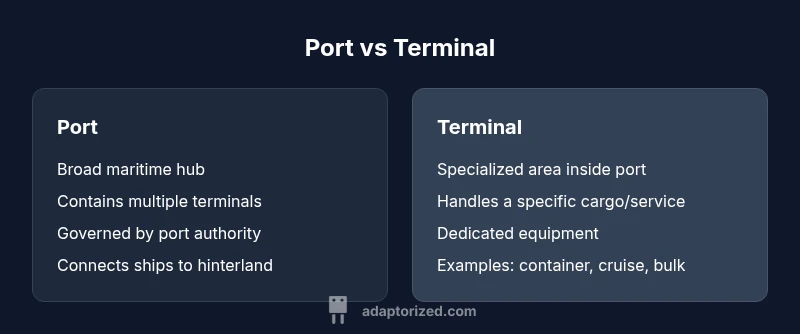
The difference between a port and a terminal is more than naming; it shapes how organizations plan shipments, allocate resources, and manage risk. In maritime logistics, a port is the broad infrastructure that enables international and domestic sea trade. It often comprises multiple berths, storage facilities, a customs area, pilotage services, and intermodal connections such as rail and road networks. A terminal, by contrast, is a specialized area inside the port that is optimized for a particular cargo type or service. Terminals can be container terminals, bulk terminals, liquid-bulk terminals, or cruise terminals. The Adaptorized team notes that while all terminals exist within a port, not every port needs to operate every terminal type. The governance structure also differs: a port authority or government agency may own the port, while a terminal operator runs a specific terminal under contract. This distinction matters for planning, pricing, and scheduling, as the terminal determines handling techniques, equipment, and turnaround times. Understanding this difference between a port and a terminal helps logistics professionals align expectations with operators, warehouses, and forwarders.
Governance and ownership structures
Port governance typically involves a public body or port authority that sets policy, assigns berths, and coordinates security, customs, and pilotage. In many regions, ports are public or semi-public entities that oversee the broader ecosystem. Terminals inside a port are often operated by private concessionaires, consortiums, or dedicated terminal companies under contract with the port authority. This split can affect pricing, scheduling, and contract terms. From an operational standpoint, the distinction matters because terminal operators focus on day-to-day handling efficiency, equipment availability, and labor management for their specific cargo profile. The Adaptorized team highlights that recognizing who operates the terminal helps shippers anticipate service levels, documentation flow, and potential bottlenecks when planning multi-terminal itineraries.
Scope and primary functions
A port’s scope is to provide the overall platform for marine trade, including vessel calls, cargo transfer, regulatory oversight, safety, and hinterland connections. The terminal’s primary function is to execute specialized work with high efficiency: container terminals optimize gantry cranes and yard flow; cruise terminals optimize passenger handling; bulk terminals optimize hopper systems and silos. In practice, the port serves as the umbrella, and the terminal delivers targeted throughput. This distinction helps logisticians map out which facilities are needed for a given shipment, whether it’s a containerized import, a bulk commodity, or a passenger cruise operation. It also clarifies which parties to engage regarding scheduling, pricing, and service level agreements.
Cargo types and service profiles
Cargo types and services are often the most obvious differentiators. A container terminal handles intermodal containers and requires quay cranes, yard tractors, and container stacks. A bulk terminal manages loose commodities such as grain or coal with loaders and conveyors. A liquid bulk terminal relies on pipelines and tank farms. Cruise terminals focus on passenger flow, immigration processing, and baggage handling. A port, by contrast, may support all these terminal types under a coordinated plan but does not necessarily own the specialized equipment used by each terminal. Understanding these profiles helps planners select the right facility for a shipment, reducing dwell times and improving reliability.
Infrastructure and equipment profiles
The infrastructure of a port includes the overall harbor area, navigational channels, dredged basins, breakwaters, and support facilities. Terminals inside the port have specialized infrastructure: container terminals with gantry cranes and automated stacks, ro-ro terminals with ramps, and cruise terminals with passenger concourses. Equipment is highly cargo-specific and optimized for throughput, safety, and vessel turnaround times. Operators must balance yard density, crane productivity, and rail or road connections to minimize vessel idle time. The distinction matters for capital planning, as terminal investments are often geared toward the cargo they serve and the service levels promised to customers. For DIYers and professionals, it’s essential to know which equipment is owned by the port authority versus the terminal operator when evaluating projects that touch maritime operations.
Regulatory and safety considerations
Ports operate under a comprehensive regulatory umbrella covering customs, security, environmental controls, pilotage, and vessel traffic management. Terminals adhere to these rules but focus on terminal-specific procedures such as cargo handling safety, lane discipline in yards, and accuracy of manifests for their scope. Navigating the regulatory landscape requires understanding the point of contact for documentation, inspections, and compliance checks. The distinction between port-level governance and terminal-level operations can influence where to submit forms, where to stage cargo, and who bears liability in case of delays or misrouting. The Adaptorized team stresses that a clear grasp of regulatory responsibilities helps avoid miscommunication and delays during complex shipments.
Operational dynamics and vessel calls
When a ship calls, the port as a whole coordinates berth assignment, tug assistance, pilotage, and berth clearance. The terminal handles the actual cargo transfer, container handling, or passenger services, depending on its specialization. Turnaround time is affected by terminal efficiency, equipment availability, and yard management. Shippers should understand that vessel calls involve multi-party coordination among port authorities, terminal operators, shipping lines, and inland carriers. A well-structured handoff between port-wide operations and terminal-level execution reduces the risk of delays and ensures smoother flows for subsequent movements in the supply chain.
Intermodal connectivity and hinterland access
Effective ports connect to rail, road, and inland waterways to move cargo inland. Terminals further tailor these connections to their cargo type; container terminals, for example, emphasize high-density intermodal containers and rail ramps to reach inland distribution centers. The hinterland strategy—how cargo moves from port to hinterland infrastructure—depends on regional geography, transport policy, and private-public collaboration. In some regions, intermodal connections are a primary differentiator in selecting a port versus a terminal, especially for just-in-time logistics and time-sensitive cargo. Understanding this connectivity helps planners optimize routes and reduce total transit time.
Regional variations and terminology caveats
Terminology varies by region. Some places casually refer to the entire harbor as a single “port,” even if several terminals operate under different operators. Others distinguish clearly between the port authority and the individual terminal companies. These variations can complicate cross-border planning if the terms are not aligned to local practice. Practitioners should check local definitions and service agreements to avoid ambiguity when booking cargo space, scheduling vessel calls, or coordinating with customs authorities. This regional nuance underscores the importance of stakeholder communication and clear documentation across borders.
How to identify the right port or terminal for your needs
Start with your cargo profile and service requirements: containerized goods, breakbulk, liquid bulk, or passenger services. Match these with terminal types within ports that offer the appropriate equipment, berths, and intermodal access. Verify transit times, storage capacity, and labor arrangements for the specific terminal operator. Consider hinterland connectivity, including rail and truck routes, to ensure predictable delivery. Finally, review port-level policies, fees, and service-level agreements to understand the broader governance factors that could affect reliability and total transport cost. This approach helps you avoid costly misalignments between a port’s capabilities and a terminal’s specialization.
Common misconceptions and practical takeaways
One common misconception is that all terminals within a port can handle any cargo. In reality, terminals are specialized for specific cargo types or services. Another misconception is that a port equals a single facility; many ports are a collection of terminals and ancillary services. The practical takeaway is to identify the cargo profile, confirm the terminal type, and verify the terminal’s equipment and schedule. This clarity helps ensure accurate quotations, realistic timing, and smoother cargo interactions. Remember: the boundary is often defined by what each terminal can efficiently handle, not merely by the port’s footprint.
Comparison
| Feature | Port | Terminal |
|---|---|---|
| Governance/Ownership | Usually governed by a port authority or government agency; multiple stakeholders | A terminal is operated by a terminal operator under contract within the port’s governance |
| Scope and Function | Broad logistics hub coordinating ships, cargo, customs, security, and hinterland access | Specialized workspace inside the port focused on a cargo type or service |
| Typical Cargo/Services | Mixed cargo, some passenger services, and regulatory oversight | Specific cargo types like containers, bulk, or cruise services |
| Infrastructure/Equipment | Overall harbor infrastructure; multiple terminals may exist | Dedicated equipment for the terminal’s cargo (gantry cranes, ro-ro ramps, etc.) |
| Regulatory/Safety Roles | Port-wide regulatory oversight (customs, security, pilotage) | Terminal-level safety and handling procedures under port rules |
| Capacity Metrics | Port-wide capacity (throughput, ship calls) | Terminal throughput or tonnage specific to its cargo |
| Intermodal Connectivity | Integrated by the port authority with rail/road links | Connected to hinterland networks specific to the terminal’s focus |
| Examples | Port of Shanghai, Port of Singapore | Container Terminal in Rotterdam, Cruise Terminal in Barcelona |
The Good
- Clarifies organizational scope for planning and budgeting
- Enables targeted optimization for specific cargo types
- Improves clarity in contract negotiations with operators
- Supports better risk and schedule management
Drawbacks
- Regional terminology variations can cause confusion
- Cross-port comparisons are harder due to different terminal profiles
- Complex ownership structures may complicate accountability
Terminals are the practical focus for most logistics tasks within a port; ports provide the broader maritime infrastructure.
In practice, you’ll interact with the terminal for day-to-day handling, while the port coordinates overall governance and connectivity. Understanding both elements helps optimize scheduling, pricing, and intermodal transfers. The Adaptorized team emphasizes aligning cargo needs with the appropriate terminal type inside a given port to minimize delays and maximize efficiency.
Your Questions Answered
What is a port?
A port is the broader maritime facility that coordinates vessel calls, cargo handling, and regulatory functions. It includes multiple berths, storage areas, and supporting services, operating under a port authority or government body.
A port is the big maritime complex where ships dock and cargo moves, managed at a high level by the port authority.
What is a terminal?
A terminal is a specialized area inside a port designed to handle a specific cargo type or service, such as a container terminal or cruise terminal. Terminals optimize equipment, staffing, and layout for their cargo profile.
A terminal is a focused workspace inside a port for a particular kind of cargo or service.
How do ports relate to terminals?
Terminals operate within ports and are usually managed by private operators under the port’s governance. The port coordinates the broader ecosystem, while terminals execute cargo handling and service delivery for their designated cargo types.
Terminals are inside ports and handle the cargo; ports oversee the big picture.
Are all ports terminals?
No. A port is the broader system; a terminal is a specialized area within that system. Some ports may have multiple terminals; others may operate only a subset of terminal types.
No—ports are the whole system, terminals are the specific work areas.
How are terminals classified?
Terminals are classified by the cargo type or service they handle, such as container, bulk, liquid, roll-on/roll-off, or passenger/cruise terminals. Each type uses different equipment and processes.
Terminals are grouped by the cargo they handle.
Who operates a terminal?
Terminals can be operated by port authorities, private concessionaires, or joint ventures. Operators run equipment, scheduling, and safety in coordination with port governance.
Terminals are run by operators under the port’s supervision.
What to Remember
- Know that a port is the broad maritime hub, and a terminal is a specialized work area inside that hub
- Identify cargo type first, then pick the terminal with the right equipment and services
- Check intermodal links (rail/road) to ensure smooth onward movement
- Clarify governance and who operates the terminal to avoid delays
- Factor regional terminology differences into your planning