Difference Between Connector and Terminal: A Practical Guide
Explore the difference between connector and terminal with clear definitions, practical guidance, and best practices for DIYers and makers in harnesses, panels, and field repairs.


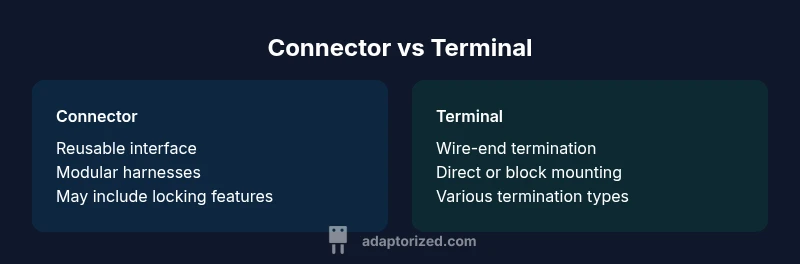
The difference between connector and terminal centers on function: a connector provides a reusable mating interface between assemblies, while a terminal is the endpoint that carries and terminates a conductor. In practice, connectors enable modular, serviceable connections; terminals provide secure wire terminations within or without a housing. For DIYers, recognizing this distinction helps you choose components for harnesses, panels, and field repairs.
What is a connector? Definition and scope
According to Adaptorized, a connector is an assembly that provides a reusable mating interface between two mating halves, often housed in a plastic or metal shell with one or more contacts. The primary role of a connector is to enable easy disconnects and reattachments in a system, so that modules, panels, or harnesses can be serviced without cutting or rewiring. Connectors are designed to be mated and unmated repeatedly, and they come in many form factors, including rectangular plug-and-receptacle styles, circular connectors, and modular multi-pin housings. In everyday projects, you’ll see connectors used to join power rails, signal lines, or data cables where future maintenance or upgrades are anticipated. Understanding that the connector is part of a larger system helps distinguish it from the terminal, the latter serving as the termination point for a wire.
What is a terminal? Definition and scope
A terminal is the end of a conductor that receives a termination or contact. Terminals come in many shapes, such as crimp contacts, screw terminals, blade lugs, ring lugs, ferrules, and push-in terminals. They are the “endpoints” that actually carry current or signals from the wire, and they can function inside a connector housing or as a standalone termination on a chassis, panel, or device. Terminals are chosen for reliable wire attachment, mechanical strength, and electrical contact quality. In practice, you’ll encounter terminals both inside and outside of connectors, depending on whether you need a reusable interface or a simple, permanent termination.
Core difference: function and connection method
At the heart of the difference between connector and terminal is function. A connector creates a modular, repeatable interface that can be mated, tested, and replaced without disturbing the entire wiring harness. A terminal is the wire-end component that makes the actual electrical connection to another part of the system—whether that connection is a screw, crimp, solder, or push-in type. In many designs, terminals are integrated into connectors, forming a complete, serviceable assembly; in others, terminals stand alone, connected directly to a terminal block or device input. The distinction matters when planning maintenance, replacements, and upgrades.
Physical form and mounting differences
Connectors typically consist of a shell or housing with receptacles and plugs, plus one or more crimp or solder contacts inside. They are designed to snap, latch, or screw together and are often keyed to prevent mis-mating. Terminals, by contrast, are small conductive elements that terminate a conductor; they can be crimped onto a wire and then inserted into a housing, or connected directly to a terminal block, screw post, or device lug. The physical footprint and mounting requirements influence enclosure space, cable harness routing, and the choice of tools required for assembly.
Electrical characteristics: impedance, ratings, and compatibility
A key consideration in choosing between a connector and terminal is electrical performance. Connectors are rated for a combination of current, voltage, and contact resistance, with the added dimension of contact matings, which introduce contact resistance at each interface. Terminals have their own ratings, including wire gauge compatibility, current handling, and insulation requirements. Compatibility between a connector and terminal depends on the contact type, crimp profiles, insulation, and the mating interface. When evaluating a design, compare datasheets for mating cycle life, worst-case contact resistance, and environmental ratings such as temperature and vibration resilience.
Common types of connectors and where they are used
Connectors come in many families: rectangular multi-pin housings for data and power, circular connectors for rugged environments, and modular plug-and-receptacle families for harnesses. They’re common in automotive harnesses, industrial control panels, consumer electronics, and field assemblies where serviceability matters. The choice depends on pin count, mating cycle life, environmental exposure, and the need for quick disconnects. When you need to replace a module without rewiring, a connector makes this feasible. In less dynamic applications, a simpler termination may suffice.
Common types of terminals and configurations
Terminals cover screw terminals, crimp contacts, push-in ferrules, blade connectors, ring lugs, and butt connectors. They’re selected for wire gauge compatibility, termination method (screw, crimp, or solder), and mounting scheme (friction-fit, clamp, or solder lands). The terminal type you choose should match the conductor size, insulation, and operating environment. Terminals are integral to achieving secure terminations and solid mechanical strength, whether used inside a connector or as a standalone harness termination.
How to decide: when to use a connector vs a terminal
Use a connector when modularity, serviceability, and ease of replacement are priorities. If you expect the assembly to be unplugged, tested, or upgraded over time, a connector is your best bet. Use a terminal when you need a robust, simple, or permanent termination, or when space constraints or cost considerations favor a direct wire-to-device connection. In many designs, you’ll combine both: terminals inside a connector housing for keyed, reliable coupling, or direct terminals on a terminal block for rugged field wiring.
Tools, crimping, and installation best practices
Crimping is a core skill for both connectors and terminals. Always use the correct crimp tool and the right crimp terminal for the wire gauge. Mis-crimping is a common failure mode and can cause high contact resistance, intermittent connections, or mechanical failure. Calibrate your tooling, verify compression with torque or crimp depth checks, and inspect each termination for proper insulation, pin alignment, and secure seating. Labeling and color-coding can help prevent misassembly and ensure consistent plug-mairment across assemblies.
Reliability, maintenance, and failure modes
Reliability hinges on contact quality, insulation integrity, and environmental exposure. Connectors may fail due to corrosion at contacts, worn mating surfaces, or improper engagement. Terminals may fail due to loose screws, frayed wires, or inadequate insulation. Regular inspection, gentle tug testing, and periodic re-termination in high-vibration or high-temperature environments are prudent. The distinction between connector and terminal remains critical for isolation of faults and ease of replacement.
Integration into systems: cable harnesses and panel wiring
In harness design, connectors organize signals and power into modular blocks, facilitating assembly in the factory or the field. Terminals anchor wires to devices, the ground plane, or blocking terminals. The system’s health depends on consistent contact preparation, clean wire ends, and precise alignment of mating interfaces. Documentation and standardized part families reduce mismatch risk and improve maintenance speed.
Practical guidelines and quick-reference tips
Always start with the intended service scenario: is the connection likely to be disconnected for maintenance? What environmental conditions will the assembly face? Choose connectors with locking mechanisms for vibration-heavy contexts and select terminals with robust insulation and strain relief for harsh environments. Keep a reference library of contact types and sizes, and verify compatibility between the chosen connector family and available terminals.
Summary: distinguishing facts you can apply today
The core difference between connector and terminal lies in role and use: connectors enable modular, serviceable interfaces; terminals provide secure, wire-end terminations. By aligning your choice with maintenance expectations, environmental demands, and data or power needs, you can craft more reliable and producible wiring solutions. This distinction informs not just what you buy, but how you assemble, test, and maintain your projects.
Final note on practice and learning
As you work on projects, developing a consistent naming scheme and a quick-reference sheet for connector families and terminal types will save time and reduce errors. Start small with a few common pairs and scale your component library as your projects grow. The practical distinction between connector and terminal becomes second nature with hands-on experimentation and methodical documentation.
Comparison
| Feature | Connector | Terminal |
|---|---|---|
| Definition | A reusable mating interface in a housing with plug/receptacle halves | An end-point contact that terminates a conductor or functions as a standalone termination |
| Typical use | Modular harnesses, removable connections, and panel-to-module interfaces | Direct wire terminations, standalone splices, or inside devices |
| Mating method | Fitted pairs with latching, locking, or friction-fit mechanisms | Direct press-on, crimp, or screw/bolt connections when used with terminals |
| Installation method | Crimping or soldering contacts inside a housing; requires mating interface | Crimping, soldering, or screwing to a conductor; may require lugs or blocks |
| Maintenance/replaceability | Easier to replace a faulty half; modular repair | Terminals can be replaced individually but may require disassembly |
| Cost and complexity | Typically higher upfront cost; more assembly steps | Often lower upfront cost for simple terminations; less complexity |
The Good
- Supports modular, scalable designs and future upgrades
- Easier maintenance through replaceable interface halves
- Improved fault isolation with standardized interfaces
- Wide compatibility across families and wire gauges
- Faster field servicing with snap-on or quick-disconnect features
Drawbacks
- Higher upfront cost and more parts to manage
- Requires tooling and training for proper crimping
- More space required in compact designs
- Risk of mating errors if incompatible families are mixed
Connectors enable modularity and serviceability; terminals offer simple, cost-effective terminations.
Choose connectors when you need reusable interfaces and easy replacements. Choose terminals for straightforward terminations and lower initial costs. In many designs, a hybrid approach offers the best balance.
Your Questions Answered
What is the key difference between a connector and a terminal?
A connector provides a reusable mating interface for assemblies, while a terminal is the wire-end termination that carries current or signals. The distinction informs whether your project prioritizes modularity or a simple, fixed termination.
The connector is the reusable link between parts, while the terminal ends the wire. For DIYers, think modular interfaces versus simple terminations.
Can a terminal be used with a connector?
Yes, terminals can be integrated into a connector housing or used as standalone terminations inside a harness. Compatibility depends on the contact type and housing design.
Terminals can live inside a connector or be used on their own, depending on the mating parts.
Which is better for high-vibration environments?
Connectors with locking features and robust contact interfaces are generally better for high-vibration settings. Terminals should be secured properly with appropriate strain relief and mounting.
Locking connectors usually handle vibration better; secure terminals with strain relief.
Are there universal standards for connectors and terminals?
There are broad industry standards governing connector families and termination methods, but specifics vary by family and application. Always consult the datasheet for ratings and mating compatibility.
Standards exist, but always check the specific family datasheet for ratings and compatibility.
What tools are required to install crimp terminals?
Use the correct crimping tool matched to the terminal and wire gauge. The right tool ensures reliable contact compression and long-term performance.
Choose the right crimp tool for your terminal and wire size to ensure a reliable fit.
How do you size a terminal for a wire?
Select terminals based on the wire gauge and current rating. Consult the terminal datasheet and ensure insulation and strain relief meet environmental requirements.
Pick a terminal that fits the wire gauge and expected current, per its datasheet.
What to Remember
- Define the role: modular interface vs termination point
- Match installation tools to the task to avoid mis-crimps
- Plan for serviceability in harness designs
- Balance upfront cost with maintenance needs
- Document families and sizes to prevent mismatches