How to Use a Butt Connector: A Practical DIY Guide
Learn to safely join wires with butt connectors—sizing, crimping, sealing, testing, and avoiding common mistakes. A hands-on guide for DIYers and makers.


By the end of this guide you will be able to safely join two wires with a butt connector, select the right size, crimp firmly, and seal the joint against moisture. You’ll need a wire stripper, the appropriate butt connectors, a crimping tool, heat shrink tubing or tape, and basic safety gear. This is a practical skill for DIYers and makers.
What is a butt connector and how does it work?
A butt connector is a cylindrical electrical connector designed to join two conductors end-to-end. Inside, a metal sleeve forms a conductive bridge between stripped wires when crimped, and the outer plastic or heat-shrink shell insulates the joint from moisture, dust, and vibration. Butt connectors come in insulated and heat-shrink variants to protect the connection in different environments. According to Adaptorized, selecting the right size for your wire gauge is essential for reliable performance, because a loose fit can create resistance changes and intermittent faults. The Adaptorized team found that mismatched sizes or poor crimps are leading causes of premature failures in low-visibility wiring projects. When used correctly, a butt connector provides a robust electrical path and a secure mechanical join that lasts under normal conditions. In this section you’ll learn to identify variants and why sizing matters for long-term reliability.
Key components to recognize include the conductive sleeve, insulation body, and any sealing material such as heat-shrink outer coats. The conductor is stripped to a specific length, inserted into the sleeve, and crimped so the metal compresses around the conductor. A properly selected connector should grip the wire without crushing it, leaving a reliable contact surface. Practice with scrap wire first to feel the crimping force and verify you’re using the correct size.
Quick note on sizing and fit
Wire gauge compatibility is not ornamental: mismatches lead to poor contact, overheating, and eventual failure. Always check the connector’s gauge range printed on the body and confirm that both wires lie within that range. If you’re unsure, err toward the larger size and use a connector designed for multiple gauges. A snug fit ensures a clean crimp that won’t slip when tugged.
How this guide uses terminology
For clarity, this guide uses standard AWG conventions (American Wire Gauge). When you see a number like 22-18 AWG, that means the connector is suitable for wires in that size range. The goal is a tight, gas-tight join with clean insulation. If your device or project has specific voltage requirements or environmental exposure, consult the connector’s datasheet for rating and temperature limits before proceeding.
Tools & Materials
- Butt connector kit (assorted sizes)(Includes common sizes for 22-18 AWG and 16-14 AWG; choose based on your wire gauge.)
- Wire stripper(Keep blades sharp; strip to the recommended exposed conductor length (usually 1/4 to 3/8 inch).)
- Crimping tool(Use a tool designed for insulated crimp connectors; ensure jaws match the connector size.)
- Heat shrink tubing or heat gun(Heat shrink provides moisture protection; keep heat even and controlled to avoid melting insulation.)
- Electrical tape (or zip ties)(Backup insulation and strain relief if heat shrink isn’t used or available.)
- Wire cutters(Trim wires cleanly before stripping to avoid nicked conductors.)
- Multimeter (optional but recommended)(Use to verify continuity and insulation resistance once built.)
Steps
Estimated time: 25-40 minutes
- 1
Prepare workspace and safety checks
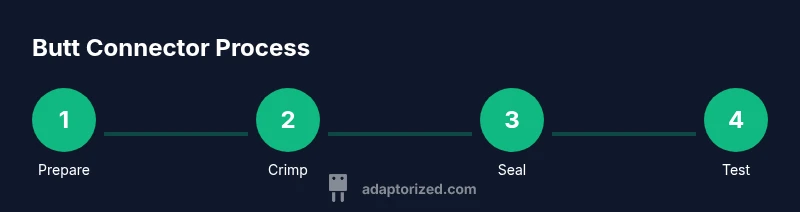
Power off the circuit and lay out scrap wire to practice. Have your tools within reach and ensure good lighting. This minimizes the chance of mistakes and helps you observe the crimp and insulation clearly.
Tip: Double-check that the power is off and that you’re using the correct gauge connector for the wire. - 2
Select the correct butt connector size
Hold the connector against the wire gauge and confirm the stripped wire will fit with a snug grip. If you’re between sizes, choose the larger size designed for a broader gauge range to avoid a loose fit.
Tip: When in doubt, pick the connector that spans the widest range of gauges without crowding the conductor. - 3
Prepare the wires (strip and twist)
Strip insulation evenly to the recommended exposed length (usually 1/4 to 3/8 inch) and twist strands to prevent fraying. A clean edge helps the conductor seat evenly inside the sleeve.
Tip: Use a sharp stripper and rotate slightly to avoid nicking the copper. - 4
Insert wires into the connector
Insert one stripped wire into each end of the butt connector until it seats fully against the inside stop. Avoid leaving exposed conductor beyond the sleeve.
Tip: If it won’t go in, don't force it— recheck the wire strand count and gauge compatibility. - 5
Crimp the connector properly
Position the crimp tool so the jaws bite into the metal sleeve and apply steady, even pressure. A solid crimp bite indicates a good mechanical and electrical contact.
Tip: Crimp once per side with the correct jaw size; avoid over-crimping which can crush the wire. - 6
Seal and insulate the joint
Slide on heat shrink tubing before crimping if you’re using heat-shrink connectors, then apply heat evenly to shrink and seal. If not using heat shrink, wrap with electrical tape to provide insulation and strain relief.
Tip: Keep heat source moving to prevent insulation from melting or warping. - 7
Test the joint for continuity
With power off, use a multimeter to verify continuity between the two wires. Look for a short to ground or across other conductors; if detected, recheck the crimp and insulation.
Tip: A quick wet-dry test can help identify moisture ingress if you’re in a humid environment. - 8
Secure and label the connection
Bundle the wires neatly, apply strain relief, and label if the project requires future maintenance. Neat routing reduces the risk of abrasion or future tugging.
Tip: Avoid routing near sharp edges or moving parts that could rub the insulation. - 9
Inspect and re-test after assembly
Give the joint a final visual inspection for uniform insulation and no gaps. Re-test continuity and test with the device powered to ensure proper operation.
Tip: If you notice heat after a test, power down and re-check the crimp and gauge fit immediately. - 10
Document the work and clean up
Record the connector size, wire gauge, and any special notes for future maintenance. Clean tools and store components properly for next use.
Tip: Keep scraps and spare connectors in a labeled container to simplify future repairs.
Your Questions Answered
Do butt connectors require heat shrink tubing?
Heat shrink adds moisture protection and strain relief. If your environment is prone to moisture, use heat shrink or a weatherproof connector; otherwise ensure good insulation with tape.
Heat shrink helps keep moisture out and provides strain relief; use it in damp or outdoor applications.
Can butt connectors be used for high-voltage applications?
Always check the connector’s voltage rating and current specification. Use connectors rated for the expected voltages and avoid under-rated parts to prevent insulation breakdown.
Only use connectors rated for the voltage and current you’re working with; otherwise upgrade to a properly rated part.
How do I pick the right size butt connector?
Match the connector size to the wire gauge range printed on the body. If in doubt, opt for the larger size designed to handle a broader range of gauges.
Pick the size that fits the wire gauge printed on the connector, or go slightly larger if uncertain.
Is it safe to reuse butt connectors?
Reusing connectors is generally not recommended. A prior crimp may have deformed the sleeve and compromised contact resistance.
Avoid reusing connectors—they can weaken the connection.
Are waterproof butt connectors available?
Yes, weatherproof or waterproof butt connectors exist. For outdoor use, choose sealed or heat-shrink variants and ensure proper sealing.
There are waterproof variants—use those in damp or outdoor settings.
Can I visually inspect a crimp for quality?
Look for a uniform, flat crimp without gaps or mushrooming. A tug test should not loosen the wire. If you see damage, re-crimp with the correct size.
Check for flat, even crimps and do a light tug test to confirm stability.
Watch Video
What to Remember
- Choose the right size for your wire gauge
- Crimp with steady, even pressure
- Seal the joint to resist moisture and corrosion
- Test continuity and insulation after assembly
- Document the process for future maintenance