Can You Reuse F Connectors? A Practical DIY Guide for DIYers
Learn whether you can reuse F connectors in coax setups, why reusing may cause signal loss, and how to safely replace connectors with a clear, step-by-step process. This guide from Adaptorized covers plugs, impedance, testing, and best practices for reliable, DIY-friendly results.


Yes, you generally should not reuse F connectors after they've been crimped or soldered. Reusing a crimped or soldered F connector can compromise impedance, introduce micro-gaps, and lead to signal loss or leakage. If you absolutely must reuse, only with a verified intact cable and a fresh, properly specified F connector, and with careful testing.
What is an F Connector and Where It's Used
F connectors are a 75-ohm coaxial RF connector commonly used for cable TV, satellite, and some broadband installations. They screw onto the coax with a center conductor passing through, forming a simple threaded junction. A frequent question in DIY circles is can you reuse f connectors after they’ve been crimped or soldered. According to Adaptorized, the impedance integrity and weather sealing of a coax run are critical for reliable performance, especially where outdoor exposure, humidity, or high-frequency signals come into play. The temptation to reuse a connector is understandable when you’re budget- or time-constrained, but the long-term impact can outweigh the short-term savings. Reusing a connector often introduces subtle impedance discontinuities that degrade signal quality and can create reflections that disrupt downstream devices. For hobbyists and professionals alike, using a fresh connector is typically the safer, more predictable choice.
What you’ll learn in this guide
- The risks of reusing F connectors and how they affect signal integrity
- Clear criteria for deciding when replacement is necessary
- A practical, step-by-step replacement workflow you can perform safely
- Testing methods to confirm a solid, low-loss connection
- How to document and label your coax runs for future maintenance
Tools & Materials
- Coaxial cable (RG6 or RG59, 75-ohm)(Match the impedance and diameter to your connector type)
- F-type connectors (crimp and compression variants)(New connectors for each install)
- Coaxial cable stripper(Precise cut without nicking the conductor)
- Crimping tool or compression tool for F connectors(Use the tool type that matches your connector)
- Cable cutter(Straight cut preferred for clean end faces)
- Heat shrink tubing or weatherproof tape (optional)(Helpful for outdoor installations)
- Cable tester or VSWR/return-loss tester (optional but recommended)(Confirms impedance and leakage after installation)
- Marker or label tags(Useful for documenting porting and run lengths)
Steps
Estimated time: 30-60 minutes
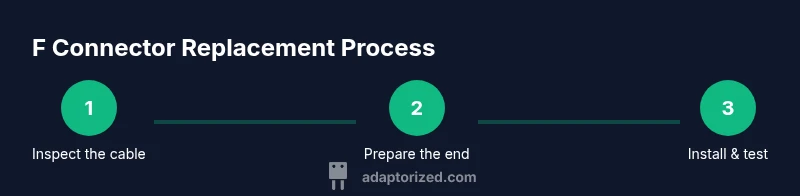
- 1
Prepare workspace
Clear a clean, well-lit workspace. Gather all tools and materials before you begin. Ensure power to any connected devices is turned off and that you have a safe, stable surface for the coax work.
Tip: Label the cable run so you can trace it later and avoid cross-connecting ends. - 2
Remove old connector and inspect cable
If an old connector is present, carefully loosen and remove it. Inspect the cable jacket, shielding, and center conductor for damage. Do not reuse a connector if you see nicked metal, crushed shielding, or corrosion.
Tip: Take a quick photo of the end for reference before you cut. - 3
Strip the cable end
Use the coax stripper to remove the proper amount of jacket, braid, and dielectric according to the connector type. Avoid nicking the center conductor and ensure the stripped length matches the connector’s spec.
Tip: Keep the center conductor clean and straight; even small burrs can affect termination. - 4
Attach the new F connector
Slide the connector onto the coax end and tighten using the appropriate crimp or compression tool. Check that the center conductor protrudes the correct length into the connector and that the braid is properly seated.
Tip: Use the correct size and type of connector for your cable; mismatches are a common source of failure. - 5
Seal and secure the connection
If installed outdoors or in moisture-prone areas, apply weatherproofing measures such as heat shrink tubing or protective tape to prevent water ingress. Ensure the connector is snug and not cross-threaded.
Tip: Verify a watertight seal by inspecting for gaps around the threaded interface. - 6
Test the connection
With the system powered, test the signal path using a basic continuity check and, if possible, a VSWR/return loss measurement. Look for stable readings and minimal reflections.
Tip: Document the test results for future maintenance and troubleshooting.
Your Questions Answered
Can you reuse a damaged F connector?
No. Damaged connectors can fail to seal and degrade impedance; replace with a new one. If you’re unsure, test with appropriate equipment after installation.
No, damaged F connectors should be replaced to maintain signal quality. Use a new connector and test the result.
What testing should I perform after installing a new F connector?
Use a VSWR or return-loss tester if available, and perform a continuity check to ensure a solid path with minimal reflections.
Test with a proper instrument to verify the connection is solid and loss is within acceptable range.
Are there exceptions where reusing an F connector is acceptable?
Very rarely. Reuse may be considered only in non-critical, controlled experiments with pristine cable and connector, and even then it’s not best practice.
Only in controlled, non-critical setups; otherwise replace.
What tools are essential for installing a new F connector?
A coax stripper, the appropriate crimp or compression tool, and a fresh F connector suited to your cable.
Have the right stripper, connector, and crimp/compression tool ready.
How can I tell when a coax run needs replacement rather than a connector?
If the cable shows wear, core damage, or frequent signal dropouts after a fix, replacement of the cable segment is advised.
If the cable itself is degraded, replace the run rather than just the connector.
Is there a difference between crimp and compression F connectors?
Yes. Crimp connectors require a crimp tool and are common for fixed installations; compression connectors seal differently and can offer a more weatherproof finish in some setups.
Crimp and compression are both valid; choose based on your tool availability and installation environment.
Watch Video
What to Remember
- New connectors are preferred for reliable coax performance.
- Inspect the cable and connector for damage before reuse.
- Use proper tools and test after installation to verify integrity.
- Weatherproofing is important for outdoor runs.
- Document your installation for future maintenance.