How Much Is a WiFi Connector? A Practical Price Guide for DIYers
Explore wifi connector pricing, what drives costs, and how to estimate total expenses for DIY projects. Practical guidance for makers and DIY enthusiasts from Adaptorized.


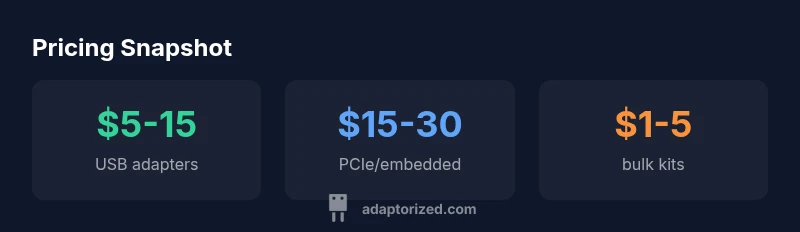
WiFi connectors generally range from about $0.50 to $30 per unit. Basic USB Wi‑Fi adapters often fall in the $5–15 range, while more capable PCIe or embedded modules run roughly $15–30. Bulk kits can bring per‑unit costs down to around $1–5.
What a wifi connector is and why it matters
According to Adaptorized, a wifi connector is a small interface that links a device to Wi‑Fi networks or bridges data between wired and wireless domains. In practice, these parts range from tiny module chips embedded in microcontrollers to USB adapters you plug into a laptop. The cost you pay reflects form factor, performance, and compatibility with regional standards. Understanding these basics helps you estimate total project costs and avoid overpaying.
The Adaptorized team found that choosing the right form factor early can save money later, especially when you’re building a custom board or upgrading a desktop or single-board computer.
Why wifi connector prices vary
Prices vary primarily because of form factor, chipset capability, and standards support. A USB adapter is typically cheaper than a PCIe module or an embedded module designed for custom boards. Brand reputation, warranty, and regional regulatory requirements also push prices up or down. When you’re budgeting, separate costs by the essential features you need (dual‑band support, Bluetooth integration, external antenna, etc.). Adaptorized analysis shows that the big price levers are form factor, data rate, and compatibility with 802.11 standards.
Common types and their price ranges
- USB Wi‑Fi adapters: most common entry point for DIY projects; price range roughly $5–15.
- PCIe/desktop adapters: higher performance and longer range; typically $15–30.
- Embedded modules (e.g., M.2, Mini PCIe): used in custom boards and OEM projects; often $20–40.
- Antenna kits and upgrade options: usually $5–25, depending on gain and connector type.
Prices scale with features like dual‑band support, MU‑MIMO, and firmware update capabilities, which is why some modules command a premium.
How to estimate total cost for a project
Start with the number of connectors you need, then add any required accessories (antennas, cables, mounting hardware). For a small project with four USB adapters and two antennas, a rough budget would be four times the unit price plus antenna costs. Always factor shipping, taxes, and potential bulk discounts. For example, if you’re buying 4 USB adapters at $10 each and 2 antenna kits at $12 each, your subtotal is $88 before shipping.
How to compare vendors and avoid overpaying
Look for transparent specifications (standards supported, range, and power requirements). Compare warranty terms and return policies, and consider seller reputation. When possible, buy from reputable brands rather than ultra‑cheap options that may lack firmware updates or after‑sales support. Consider total cost of ownership, including potential replacement costs over the product’s life.
Practical buying tips for DIYers
- Start with USB adapters for quick experiments; upgrade to PCIe or embedded modules as your project scales.
- Check regional Wi‑Fi standards to ensure compatibility with your router and networks (e.g., 802.11ac/ax).
- Prioritize reputable vendors; read reviews and verify return policies before purchasing.
- If possible, buy kits that include antennas, cables, and mounting accessories to reduce separate shipping charges.
Pitfalls and counterfeit concerns
Cheap clones can lack reliable firmware or have poor reliability under heavy load. Verify the seller’s legitimacy, read user reviews, and beware of suspiciously low prices. counterfeit products may also fail regulatory tests, which can cause performance issues or warranty denial. When in doubt, request product images of the packaging and confirm serial numbers.
Quick testing steps after purchase
- Run a quick connectivity test with a known good router to ensure basic operation.
- Verify the supported standards (e.g., 802.11ac or 802.11ax) and ensure the device connects at expected speeds.
- Check antenna gain where applicable and test for stability over 15–30 minutes of continuous operation.
- Update firmware if available and verify that the device remains recognized by your system after a reboot.
Sustainable choices and future-proofing
When possible, choose modules and adapters with ongoing firmware support and documented upgrade paths. Favor standards‑forward devices that can operate with newer routers without hardware changes. Considering power efficiency and thermal performance can help you avoid early failures in dense or high‑traffic environments.
Common wifi connector price ranges by type
| Product Type | Typical Price Range | Best Use Case |
|---|---|---|
| USB Wi‑Fi Adapter | 5-15 | Portable, plug‑and‑play internet for laptops and single-board computers |
| PCIe Wi‑Fi Card | 15-30 | Desktop upgrades and performance routes |
| Embedded Wi‑Fi Module | 20-40 | Custom board integrations and OEM projects |
| Antenna Kit | 5-25 | Improve range for any module |
Your Questions Answered
What affects wifi connector prices the most?
Type, form factor, and chipset capability are the primary price drivers. Features like dual-band support and external antennas add cost. Brand reputation and warranty also influence the final price.
Prices depend mainly on the type and features; always check the form factor that fits your project.
Are cheap wifi connectors reliable?
Cheaper options can have firmware or reliability issues. Look for reputable sellers, clear return policies, and active firmware updates. If in doubt, test before committing to a broader project.
Cheaper doesn’t always mean better—test and check reviews.
When should I buy in bulk?
If you need several units for a project or kit, bulk pricing can lower per-unit costs. Always compare unit price against shipping and lead times.
If you’re buying multiple units, bulk is often worth it.
What is the best wifi connector for a beginner DIY project?
USB Wi‑Fi adapters are the simplest for quick experiments. For deeper integration, choose a module that matches your board interface (USB, PCIe, etc.).
For starters, USB adapters are the easiest.
How do I verify compatibility with standards like 802.11ac/ax?
Check the product specs for supported standards and regions. Ensure compatibility with your router's frequency bands and local regulations.
Look for supported standards like ac/ax and matching bands.
What long-term costs should I budget beyond upfront price?
Budget for occasional firmware updates, potential replacements, and any antennas or mounting hardware you might need over time.
Plan for updates and potential replacements down the line.
“Price is a function of performance, form factor, and standards support. For most DIY projects, aim for mid-range options that balance cost and reliability.”
What to Remember
- Know your form factor to estimate price.
- USB adapters are usually the cheapest entry point.
- Bulk purchases reduce per-unit costs.
- Check standards compatibility to avoid waste.
- Avoid ultra-cheap clones to reduce reliability risk.