Difference Between Connector and API: A Practical Guide
Explore the difference between connectors and APIs with a detailed, objective comparison. Learn how each works, where they fit in modern architectures, and how to choose the right approach for hardware, software, and hybrid systems.


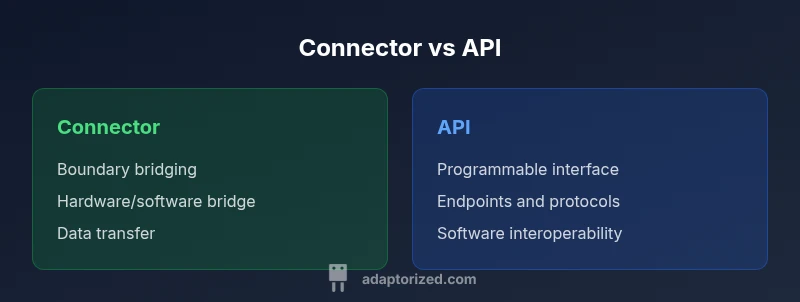
According to Adaptorized, the difference between connector and api hinges on scope: a connector is the bridge that links systems—hardware, firmware, or software—facilitating data transfer or signaling. An API, by contrast, is a defined software interface that lets programs interact. In practice, choose a connector for boundary bridging and an API for programmable access.
The practical question: what is a connector vs an API?
Understanding the difference between connector and api is not just semantics; it shapes project scope and vendor decisions. In practical terms, a connector is the bridge that links two environments, enabling data to move or signals to be exchanged. A traditional hardware connector like USB-C, or a software connector such as a message broker bridge, binds systems at a boundary. An API, on the other hand, defines the rules for software-to-software interaction, specifying endpoints, protocols, and data formats that applications use to request services. The distinction matters for DIYers and professional developers because it determines where you implement logic, how you secure interfaces, and how you evolve the integration over time. According to Adaptorized, recognizing that connectors and APIs serve different roles helps you design resilient architectures that can scale and adapt as technology stacks shift.
Core definitions: connector and API explained
A connector is a bridge that links two environments, enabling data movement or signaling. This can be a physical interface like USB-C or HDMI, a software bridge like a middleware adapter, or a data-path at the boundary between devices and applications. An API, in contrast, is a contract that defines how software components talk to each other—endpoints, request formats, authentication methods, and the semantics of each operation. In practice, APIs are the programmable doors that developers use to request services, fetch data, or trigger actions. Both concepts exist in a spectrum: connectors can wrap API calls, and APIs can drive data through connectors. Understanding this helps you architect flexible systems that can evolve without breaking critical integrations.
Boundaries and scope: hardware vs software boundaries
Boundaries matter. A connector is often described in terms of the boundary it crosses—between devices, between firmware and hardware, or between software modules. It establishes a channel for data, signals, or control flows. An API defines how software components interact once the boundary is crossed, specifying the allowable operations and the data formats. This distinction is especially important in IoT and enterprise integrations, where a device may expose a physical connector for power and data while the software layer provides APIs for application-level control. When designing systems, map each boundary first: where does data cross, and who or what governs that crossing?
Programmability and control: where APIs shine
APIs shine in the realm of programmability. They enable developers to compose, automate, and orchestrate services across software ecosystems. REST, GraphQL, gRPC, and SOAP are common API styles, each with trade-offs around verbosity, speed, and tooling. APIs support versioning, access control, and audit trails—critical for governance and compliance. Connectors can also carry programmable logic (e.g., middleware that transforms data before it passes through) but their primary strength lies in bridging boundaries. In a hybrid system, you might use a connector to move data from a device to a gateway, and an API to allow software applications to query or update that data.
Data models and formats: how data moves
Data movement hinges on formats and schemas. Connectors often handle low-level data framing (binary streams, protocol handshakes) and may perform light transformations. APIs standardize data exchange through structured formats like JSON, XML, or protocol buffers, with schemas that evolve under versioning discipline. The choice influences latency, bandwidth, and compatibility. A well-designed API includes documentation, sample requests, and clear error semantics; a robust connector handles compatibility with legacy hardware, safe reconnects, and resilient transport. When both exist in a stack, ensure the connector preserves data fidelity while the API preserves semantic clarity for downstream applications.
Interaction patterns: polling, streaming, callbacks
APIs support diverse interaction patterns: request/response, streaming, event-driven webhooks, and asynchronous messaging. Each pattern affects responsiveness and scalability. Connectors typically embody continuous or periodic data movement at a boundary, with polling or event-driven triggers understood at the hardware or middleware level. Hybrid systems often use a combination: a device exposes a simple bridge (connector), while the software layer calls APIs to fetch or push data. Understanding these patterns helps you design reliable data flows and avoid bottlenecks or stale information.
Lifecycle and versioning considerations
Versioning underpins stable integrations. API versioning is explicit: endpoints, schemas, and error codes evolve with backward compatibility strategies. Connectors face lifecycle considerations too—firmware updates, hardware revisions, and driver compatibility can break existing setups if not managed. A robust strategy aligns API versioning with connector updates, ensuring coordinated upgrades across devices, gateways, and software services. Change management, testing environments, and clear deprecation timelines are essential for minimizing disruption during evolution.
Security and governance implications
APIs demand strong identity and access management: API keys, OAuth, TLS, and granular scope controls. Auditing and monitoring are vital to detect anomalous use. Connectors introduce different security concerns: physical access, tamper resistance, and secure data paths through hardware and middleware. Governance should cover both layers—define who can connect, what data flows, and how changes are approved. In practice, you need a layered security model that spans hardware, middleware, and software, with explicit policies for updates, rotations of credentials, and risk-based access controls.
Performance and cost considerations
APIs incur ongoing costs related to hosting, bandwidth, and scale with client demand. Latency-sensitive applications benefit from optimized protocols, edge caching, and efficient serialization. Connectors likewise impact cost via hardware procurement, maintenance, and the efficiency of data movements at the boundary. A thoughtful architecture minimizes round-trips, compresses data where possible, and leverages edge processing to reduce backhaul. Consider total cost of ownership across the entire integration lifecycle when choosing between or combining connectors and APIs.
Real-world scenarios: IoT, enterprise, and consumer tech
IoT devices frequently rely on physical connectors for initial setup and data transfer, while APIs enable cloud-based control, analytics, and orchestration. In enterprise systems, connectors may bridge legacy ERP systems to modern microservices, with APIs exposing modern capabilities to new apps. Consumer platforms might ship with simple hardware connectors for accessories and robust APIs for third-party developer ecosystems. Across scenarios, the most resilient architectures blend both concepts, keeping hardware stability with flexible software interfaces.
How to evaluate your build: checklists and heuristics
When evaluating your integration, start with boundary mapping: where data crosses, who governs it, and what needs to be transformed. Then assess programmability: do you need open APIs for developers, or is a fixed data path via a connector sufficient? Consider data formats, latency, and reliability requirements. Security and governance should be defined early: who can access which data, how credentials are rotated, and how incidents are detected. Finally, plan for future changes: can the architecture evolve without breaking existing integrations? A clear checklist helps you avoid common misalignments.
Next steps and best practices
In practice, adopt a hybrid approach where appropriate: use connectors to bridge hard-wired boundaries and APIs to enable software-driven interoperability. Document contracts meticulously, maintain versioned schemas, and implement automated tests across hardware and software layers. Invest in governance, observability, and incident response that span both domains. The most robust systems treat connectors and APIs as complementary tools, each chosen for its strengths in the given context.
Comparison
| Feature | Connector | API |
|---|---|---|
| Definition | Bridge that links systems or hardware to enable data transfer and signaling | Defined software interface exposing endpoints and operations for programmatic access |
| Primary use | Boundary bridging and data/signaling between environments | Software interoperability and programmable interactions between applications |
| Typical data flow | Low-level data transfer, signaling, and sometimes light transformation | Structured requests/responses over networks using standard protocols |
| Implementation medium | Physical interfaces, middleware bridges, or device-level wrappers | Network protocols (HTTP, gRPC, GraphQL, SOAP) and data formats |
| Security considerations | Physical access controls, device integrity, and secure transport at the boundary | Authentication, authorization, encryption, input validation, and monitoring |
| Versioning | Hardware/firmware revisions and compatibility specs | API versioning, contract-first design, backward compatibility |
| Best for | Bridging boundaries, hardware integration, legacy-to-modern transitions | Software interoperability, developer ecosystems, modular architectures |
The Good
- Bridges disparate systems at the boundary, enabling data movement
- Isolates changes to a boundary, reducing ripple effects
- Supports modular, plug-and-play architectures across hardware and software
- Provides clear upgrade and maintenance paths for boundary-critical systems
Drawbacks
- Requires careful mapping of data formats and protocols
- Physical connectors can constrain design and wear out over time
- APIs require governance and security controls to prevent abuse
- Hybrid architectures can be more complex to manage and test
APIs and connectors are complementary; choose based on boundary needs and programmability requirements.
API-first thinking drives software interoperability and governance, while connectors enable reliable boundary bridging. In mature architectures, you typically use both to maximize flexibility and resilience.
Your Questions Answered
What is a connector?
A connector is a bridge between two environments that allows data or signals to move across a boundary. This can be a physical interface on a device or a software bridge that links two systems. Connectors focus on enabling the transfer of information and maintaining boundary integrity.
A connector is the bridge that lets two parts talk across a boundary, whether hardware or software.
What is an API?
An API is a defined software interface that exposes operations and endpoints for applications to consume. It standardizes how software components interact, including data formats, authentication, and error handling.
An API is a defined software interface that lets apps request services and data.
Can you use both a connector and an API together?
Yes. In many systems, a connector bridges a boundary to move data, while APIs provide the programmable access to that data for software components. Designing with both in mind is common in modern architectures.
Absolutely—connectors bridge boundaries and APIs program interactions across those boundaries.
Where should I start when deciding between them?
Begin with the boundary and programmability needs: does the project require hardware-software bridging, or do you need flexible software interactions? Use both when necessary, but define contracts and security early.
Start by mapping the boundary and what needs to be programmable, then decide which tool fits best.
How do security and governance differ between connectors and APIs?
APIs focus on identity, access controls, and encryption for software services. Connectors introduce physical and boundary security concerns, requiring tamper-evidence and secure data paths as well as software safeguards.
APIs rely on access controls and encryption; connectors emphasize boundary security and physical integrity.
What are common mistakes when distinguishing between the two?
Mistakes include conflating transport with interface, assuming a single solution solves all problems, and overlooking lifecycle and governance across both hardware and software layers.
Common pitfalls are mixing up transport with interface and neglecting lifecycle planning.
What to Remember
- Define the integration boundary and its requirements first
- Prioritize APIs for software-centric interfaces and data access
- Use connectors to bridge hardware and legacy systems
- Plan governance and lifecycle across both domains