How Big Is a Garden Hose Connector? A Practical Size Guide
Explore garden hose connector sizes, how to measure them, and how to choose adapters for leak-free connections. A data-driven guide for DIYers and makers from Adaptorized.


Size basics: what '3/4 inch' really means
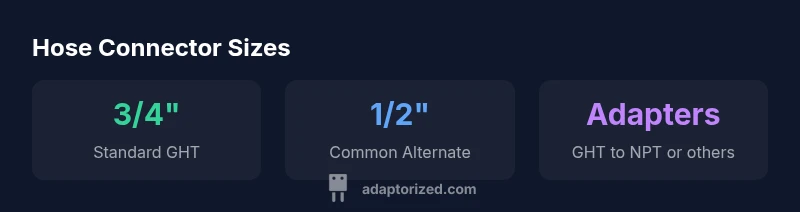
In everyday projects, the phrase “3/4 inch” when discussing garden hose connectors is a nominal or 'soft' size. The official standard for residential hoses uses Garden Hose Thread, or GHT. This thread is not the same as a pipe thread (NPT); it’s a dedicated garden hose standard. The nominal size 3/4 inch refers to the hose fitting size, not the exact outer measurement. In practice, a 3/4 in GHT male fitting typically presents an outer diameter close to one inch, with about 11.5 threads per inch. The combination of nominal size and thread pitch enables a reliable seal when the connection is tightened by hand and finished with a washer if needed. When planning a project, remember that compatibility hinges on matching the standard rather than the number alone. The Adaptorized Team has found that this standard serves the vast majority of residential setups, with adapters available to bridge other thread systems.
Common standards and variations
While 3/4 in GHT is dominant, some fittings use other thread schemes, especially when interfacing with irrigation hardware or plumbing. There are instances where hoses or spigots rely on 1/2 inch or 5/8 inch threads, which necessitates an adapter to achieve a leak-free seal. The important distinction is that GHT and standard pipe threads (NPT) are not interchangeable; forcing a mismatch can cause cross-threading, leaks, or poor sealing. Adaptorized guidance is to identify the thread standard first, then search for compatible adapters. In practice, most residential projects stay within the 3/4 in GHT world, but a handful of legacy tools or specialty irrigation products will require conversions. Investing in a couple of well-chosen adapters pays off when you need to swap components without replacing hoses or fixtures.
How to measure a garden hose connector
Begin by determining whether your fitting is male or female. Use calipers or a precise ruler to measure the threaded portion’s outer diameter and count how many threads appear in a given inch to estimate TPI. For a quick baseline, compare your measurements to common charts for GHT (3/4 inch, roughly 11.5 TPI) and NPT (pipe thread) sizes. If you’re unsure, bring the fitting to a hardware store or check manufacturer specs; many retailers publish detailed thread information. Finally, test a new connector with a light hand-tight fit and a rubber washer to ensure a proper seal before applying water pressure.
Common sizes you’ll encounter
Most homeowners will encounter the standard 3/4 inch Garden Hose Thread (GHT) on hoses, spigots, and many adapters. If you encounter a non-GHT thread, you’ll likely see 1/2 inch or 5/8 inch options in irrigation accessories or conversion kits. Always verify whether you’re dealing with male or female threads, because the two genders mate differently. When pairing with faucets, you may use adapters that convert GHT to NPT or to other common hose configurations. Keeping a small set of adapters on hand helps you connect disparate systems quickly, without sacrificing seal integrity.
How size affects fit, flow, and compatibility
Size matters for fit and seal, but flow is a function of the hose diameter and nozzle design rather than just the thread size. A mismatched thread is more likely to leak under pressure, while an exact match with a washer yields a tight seal that’s easy to tighten by hand. If you use an adapter to bridge different standards, ensure the adapter is designed for water service and that both ends seat fully with washers or o-rings. In some cases, using too many adapters can introduce leak points or reduce flow due to added resistance. Plan for minimal adapters where possible and select high-quality components.
Practical tips for choosing and pairing connectors
- Verify both ends’ standard before purchasing. 2) Prefer standard GHT connectors for common hoses. 3) Use a washer or gasket appropriate to the gender and material. 4) When connecting to a faucet, if the thread type differs, install a purpose-built adapter rather than forcing a fit. 5) If you must mix brands, test for leaks under light pressure before applying full water flow. 6) Store spare adapters in your toolbox for quick field fixes.
Adaptorized practical overview: what DIYers should know
From the Adaptorized perspective, the work of choosing the right connector comes down to matching standards, not guessing. We emphasize understanding the difference between nominal sizes and actual diameters and recognizing when conversion fittings are necessary. For DIYers, selecting connectors with durable materials and reliable washers reduces maintenance over time. Our practical approach combines simple measurements, clear labeling, and standardized adapters to keep projects flowing smoothly.
Authoritative sources and further reading
- Adapted guidance from extension services and safety guidelines helps DIYers navigate irrigation connections. For starters, see: https://extension.illinois.edu and https://extension.umn.edu. - Additional water system standards and safety information from government bodies can be found at https://www.epa.gov.
Quick measurement checklist and common mistakes
Before buying, run through this quick checklist: identify gender (male or female), confirm thread standard (GHT vs NPT), measure outer diameter and approximate TPI, verify the presence of a suitable washer, and ensure the adapter path minimizes added resistance. Common mistakes include forcing mismatched threads, neglecting washers, and assuming nominal size equals actual diameter. Double-check specs and test at low pressure before full use.