4 Wire Trailer Connector Diagram: Wiring Guide and Troubleshooting
Learn how to read a 4-wire trailer connector diagram, identify each wire function, and safely wire or troubleshoot a trailer harness with practical steps for DIYers and makers.


Goal: identify the four-wire trailer connector diagram and confirm wire functions for safe towing. You’ll learn standard color codes, how to read a wiring diagram, and practical steps to wire, test, and troubleshoot a 4-wire flat trailer harness. This guidance applies to common US and international setups, with notes on regional variations.
What a 4-wire trailer connector diagram shows
A 4-wire trailer connector diagram is a compact schematic that maps the electrical circuits you need to run lights on a trailer when connected to a tow vehicle. In the most common setups, there are four active circuits: ground, tail lights (running lights), left turn/brake, and right turn/brake. The diagram ties these circuits to a standard 4-pin flat connector used on many trailers and vehicle tow hitches. The diagram indicates which wire color corresponds to each function, how the connectors pair with each circuit, and where to land the wires on both the vehicle and trailer sides. Ground wires are typically white, while the other wires power the lighting circuits. This common arrangement reduces confusion during installation and makes it easier to diagnose lighting issues. According to Adaptorized, understanding this diagram is a foundational skill for DIYers, reducing miswiring and making future maintenance straightforward. Adaptorized Analysis, 2026, emphasizes that practitioners who learn to read and reference these diagrams are better prepared to troubleshoot lighting issues, ensure compliance, and complete wiring with confidence.
Wire functions and color codes
Most 4-wire trailer harnesses use four color-coded conductors. White is ground, returning to the vehicle chassis. Brown powers the tail lights and marker lights. Yellow carries the left-turn and stop/brake signal. Green carries the right-turn and stop/brake signal. Some harnesses may switch colors or reuse wires for multiple functions in compact connectors, or use nonstandard colors due to aftermarket adapters. Always verify by checking the wiring diagram on the harness or using a multimeter to confirm continuity to the vehicle’s lighting circuits. If your trailer uses a separate ground strap, ensure it is bonded to the trailer frame. Regional variations exist, so refer to your local standards and the vehicle’s manual. Adaptorized notes that color codes are intended to be a guide; always confirm before cutting or splicing.
Reading the diagram in practice
Start at the vehicle harness end and trace each wire to its endpoint on the trailer connector. Use the color code as a map, then verify with a test light or multimeter while operating the corresponding light on the vehicle. On the trailer side, identify which terminal corresponds to each function, sometimes using a legend printed on the trailer connector housing. If you encounter a nonstandard color, consult the diagram or trace the wire to the light cluster to confirm the function. The ability to read these diagrams quickly saves time and reduces the risk of blowing fuses or creating false indications.
Regional standards and variations
Different regions may adopt slightly different conventions or connector types. In the United States and many other regions, the common 4-pin flat trailer connector is widely used. SAE standards (e.g., J1128) guide general vehicle wiring and trailer interface, but actual color codes can vary by manufacturer and aftermarket adapters. Always check the label on your harness or the manufacturer documentation. If you can’t locate documentation, contact the installer or refer to authoritative sources such as NHTSA or SAE publications.
Wiring a harness: practical approach
Plan your wiring layout before you touch the wire. Identify a clean path to run the wires, away from hot surfaces, moving parts, and pinch points. Cut wires to length allowing extra slack for movement, and consider using weatherproof butt connectors or solder-and-heat-shrink joints. Use a dedicated ground path to the vehicle chassis and ensure a solid bond. Take care to maintain color-coding as you connect.
Testing the wiring with a tester
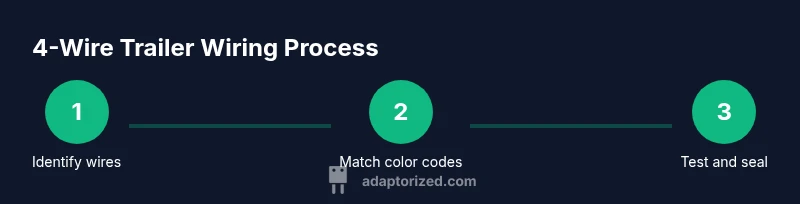
With the trailer connected to a vehicle that is on or in accessory mode, use a test light or multimeter to verify each circuit. Ground the test lead on the vehicle body, energize the lights, and confirm that each function (tail light, left and right turn signals) lights up in the expected combination. Record the results for future maintenance. If something doesn’t light, re-check the connections, ensure the ground is solid, and inspect for damaged insulation.
Safety and weatherproofing
Weatherproofing is essential for longevity. Use heat-shrink tubing or weatherproof butt connectors, and apply sealing compounds to ensure moisture does not penetrate joints. Avoid bare copper exposure; label each wire to prevent future confusion. Disconnect power when making changes and test only after the harness is reassembled.
Diagram references and cheat sheets
Keep a copy of the 4-wire diagram in your project notes. A one-page reference chart showing color-to-function mapping speeds future work. Use a simple legend: White = Ground, Brown = Tail, Yellow = Left, Green = Right.
Common mistakes and how to avoid them
Rushing through connections, ignoring ground, or mixing up colors leads to non-functional lights or safety hazards. Always test after every major connection, label each wire, and avoid reusing damaged wires. Forgetting to bond the trailer ground to the trailer frame is a frequent issue; ensure a clean metal-to-metal contact.
Documentation and maintenance
Document the wiring diagram, including wire colors, connector pin numbers, and any deviations from the standard. Store this information with the trailer or in a project notebook. Regularly inspect the harness for cracked insulation and corrosion at connectors, and re-seat or clean connections as needed.
Tools & Materials
- Digital multimeter(Set to measure DC voltage and continuity to test circuits.)
- Test light or circuit tester(Used to verify live power and signal presence.)
- Wire stripper/crimper(For clean, secure terminations.)
- Weatherproof butt connectors(Provide moisture resistance and solid connections.)
- Heat shrink tubing(Seal joints against moisture and corrosion.)
- Electrical tape and labels(Label wires for easy future reference.)
- Soldering iron and solder(Optional for permanent, low-resistance joints.)
- Safety gear (gloves, eye protection)(Protect during wiring work.)
Steps
Estimated time: 60-90 minutes
- 1
Prepare your workspace
Clear the area, disconnect power, and lay out tools. Inspect the trailer and tow vehicle connectors for corrosion or damage before starting.
Tip: Do not work with live circuits; disconnect the battery or power source first. - 2
Identify wire functions on the vehicle harness
Locate and label the four wires on the vehicle harness using the diagram or owner’s manual. Confirm which color corresponds to ground, tail lights, and left/right signals.
Tip: If colors don’t match the standard, don’t assume—use a multimeter to verify continuity. - 3
Expose and prepare the trailer end
Carefully expose the trailer-side wires, trim any damaged insulation, and prepare the ends for termination.
Tip: Leave extra slack to prevent strain on connections. - 4
Connect wires by function, not color alone
Match each function to its wire on both vehicle and trailer sides using the color map. Use proper connectors and avoid cross‑talk between circuits.
Tip: Double-check pin numbers if the connector has labeled terminals. - 5
Secure and weatherproof the joins
Crimp or solder wires, then apply heat shrink and weatherproof covers. Ensure strain relief at every joint.
Tip: Test each joint after sealing to catch weak connections early. - 6
Mount and protect the connector
Attach the connector to a sturdy surface with appropriate mounting hardware. Route cables away from heat and moving parts.
Tip: Keep the wiring away from road spray and debris; seal entry points. - 7
Test each circuit with a live signal
With the vehicle in accessory mode, check tail lights, brake/turn signals, and the ground connection using a test light or multimeter.
Tip: Document results so future work can reference the test outcomes. - 8
Document the wiring diagram
Create a simple diagram or label the existing harness with color-function mapping for future maintenance.
Tip: Store in a weatherproof location near the trailer fuse box or hitch area. - 9
Final verification and cleanup
Reconnect power, perform final checks, and tidy up any loose wires. Confirm all lights function together when braking and turning.
Tip: Take photos for your reference and safety records.
Your Questions Answered
What is the function of each wire in a 4-wire trailer connector?
White is ground, Brown powers tail/running lights, Yellow is left-turn/brake, and Green is right-turn/brake. These are the four circuits needed for basic trailer lighting.
White is ground, Brown is tail lights, Yellow is left turn, Green is right turn.
Are all 4-wire harnesses the same color coding?
Most use white, brown, yellow, and green, but some manufacturers or adapters may vary. Always verify with the harness documentation or test the circuits.
Colors can vary; always verify with the diagram and a test.
Can I convert a 4-wire harness to a 7-way connector?
Adapters exist to convert a 4-wire output to a 7-way system, but this changes how signals are distributed and may require a dedicated converter or a vehicle-specific harness.
Adapters exist, but check compatibility and regulations before converting.
How do I test the wires with a multimeter?
Set the multimeter to DC voltage and continuity. Energize each circuit with the corresponding signal and verify the expected response on the trailer lights.
Use a multimeter to verify power, ground, and signal continuity.
What gauge wire should I use for a 4-wire harness?
Use the wire gauge recommended by your harness and local electrical codes. Do not substitute undersized wire, which can overheat and fail.
Use the recommended wire size; don’t improvise with undersized wires.
Do I need weatherproofing for trailer wiring?
Weatherproofing reduces moisture intrusion and corrosion. Apply heat shrink seals and weatherproof connectors where exposed to the elements.
Yes, weatherproofing helps your trailer lights last longer.
Watch Video
What to Remember
- Know the four wire colors and functions.
- Test circuits before finalizing connections.
- Use weatherproofing to protect joints.
- Document your wiring for future maintenance.