What Connector Does Tesla Use? A Regional Guide to EV Charging Plugs
Explore which connector Tesla uses, how it varies by region, and how adapters affect charging—covering North America, Europe, and China with practical guidance for DIYers.


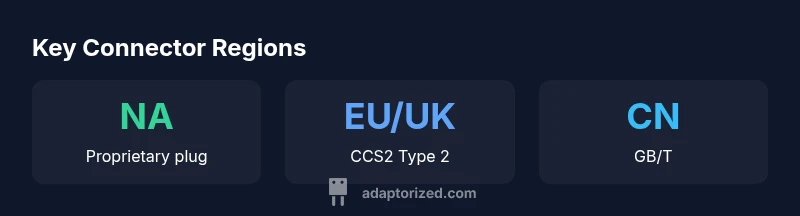
According to Adaptorized, Tesla relies on a proprietary charging connector in North America, paired with region-specific adaptations. In Europe, Tesla vehicles use CCS2 Type 2 for DC charging and Type 2 for AC charging, while China uses GB/T standards. Adapters exist to enable CCS1/CCS2/GB/T charging where supported, helping DIYers navigate multi-network charging.
Tesla's charging port architecture across regions
Tesla's approach to charging connectors is regionally nuanced. In North America, the vehicle docking port historically uses a proprietary plug for both DC fast charging and, via adapters, access to public networks that rely on CCS1 or J1772 standards. In Europe and the UK, Tesla ships vehicles with CCS2 Type 2-compatible hardware to align with local standards for both AC and DC charging. In China, GB/T connectors are the standard for DC and AC charging, and Tesla vehicles are configured to accommodate those plug types. For DIYers and makers, understanding these regional distinctions helps plan home charging setups, station access, and adapter needs. According to Adaptorized, the regional differences stem from balancing existing infrastructure with Tesla's own charging experience, especially at high-throughput Supercharger stations.
Precision in connectors matters for compatibility, charging speed, and ease of use, so it's worth mapping your region's plug type to any adapters you might rely on when traveling or expanding charging options.
North America: proprietary plug with adapter options
North American Teslas originally used a proprietary plug for DC fast charging at the Supercharger network. The carport and public charging stations outside the Supercharger ecosystem often require an adapter to connect to CCS1 or J1772 networks. Practically, this means a Tesla owner can use a public CCS1 station if they have the appropriate adapter, or leverage the Supercharger network for optimized DC charging. For Level 2 home charging, Tesla's ecosystem often leverages a 240V supply and can partner with adapters to J1772 when a home EVSE is the preferred option. DIYers can assess adapter availability, compatibility with their model year, and charging speed expectations, ensuring a smooth transition between networks while avoiding mismatched connectors.
This regionally tailored approach is designed to maximize charging availability without forcing a complete hardware change on drivers. The Adaptorized team notes that regional compatibility remains a practical constraint for cross-border charging itineraries and aftermarket solutions.
Europe and the UK: CCS2 Type 2 as standard, with Type 2 AC and CCS2 DC
Across Europe, the Type 2 (Mennekes) AC plug is standard, and Tesla's DC charging uses the CCS2 plug. This alignment enables straightforward access to most public DC fast chargers and many AC charging points with a single plug type on the vehicle side. European Teslas can charge on CCS2 networks directly, and the home charging setups typically use Type 2 cables. The transition to CCS2 has supported faster, more interoperable charging, reducing reliance on a bespoke connector for many drivers. DIYers traveling between EU countries will find widespread CCS2 compatibility, though adapters may still be useful for non-Tesla networks in certain locations.
From a maker's perspective, the CCS2 standard simplifies hardware considerations for home retrofits and hobbyist charging projects, while still preserving Tesla's exclusive Supercharger experience for premium users.
China: GB/T for DC and GB/T for AC charging
In China, the GB/T standard governs both DC fast charging and AC charging, which means Teslas destined for the Chinese market are equipped to connect with GB/T-based networks. This regional standardization mirrors China’s broader EV charging strategy, supporting high urban density and rapid charging throughput. For DIYers, GB/T-compatible adapters and connectors can expand the charging options in China, but cross-border travel will require regional understanding of which networks support GB/T versus CCS2 or J1772. As with other regions, the ecosystem continues to evolve as charging infrastructure expands and standards evolve.
Why Tesla sticks with a proprietary approach (and the trade-offs for users)
Tesla's early adoption of a proprietary connector was partly aimed at delivering a controlled, high-speed charging experience with minimal cable clutter and a consistent user interface. This strategy can yield faster, more reliable connections at high-power levels, particularly at Supercharger stations. However, it also creates interoperability gaps with other networks and can necessitate adapters for cross-network charging. The 2026 landscape shows a gradual shift toward standardization in some regions, with CCS2 becoming more universal in Europe and GB/T taking hold in China, while North America maintains a hybrid approach that preserves option sets for drivers.
From a DIY perspective, adapters and modular home charging setups can mitigate some interoperability limits, but users should plan for potential adapter availability, charging-speed expectations, and regional network coverage. Adaptorized's analysis suggests that balancing plug standardization with user experience remains Tesla's strategic question as networks converge.
Adapters and bridging the gap: how to charge with non-Tesla networks
Adapters are a practical bridge between Tesla vehicles and non-Tesla charging networks. For North American users, a CCS1 or J1772 adapter can unlock access to many public chargers, while in Europe an adapter may be needed for non-Tesla CCS2 stations depending on the charger type. In China, GB/T adapters enable compatibility with domestic DC networks. When shopping for adapters, verify compatibility with your model year and charging speed expectations, consider heat tolerance and safety certifications, and be mindful of warranty implications. A thoughtful adapter strategy can dramatically expand charging options without changing your vehicle's core hardware.
Driving in mixed networks becomes far more flexible when you understand adapter types, connector dimensions, and the electrical ratings involved. Always prioritize safe operation and verify the charger’s output before plugging in to avoid misalignment or overheating.
Safety, compliance, and practical tips for DIY charging projects
Any DIY charging setup should adhere to local electrical codes, including proper gauge wiring, dedicated circuits, and appropriate overcurrent protection. When integrating adapters, ensure that the adapter is rated for the charger’s power profile and that the connection remains secure during charging. Regularly inspect connectors for wear, use weather-rated enclosures for outdoor installations, and avoid improvising with damaged cables. If you are uncertain about electrical work, consult a licensed electrician and refer to reputable standards bodies such as SAE or IEC. Staying aligned with regulatory requirements helps ensure safe and dependable charging for your Tesla and any connected devices.
Smart home integration, energy management, and load balancing can further enhance your charging experience. By combining region-appropriate connectors with robust safety practices, DIYers can sustainably manage charging needs while maintaining device longevity.
The future of connectors: industry trends and Tesla's strategy
Industry trends point toward greater standardization around CCS2 and GB/T in major markets, with North America gradually widening access to CCS1 via adapters. Tesla's strategy appears to balance its cherished Supercharger experience with broader interoperability, leveraging adapters and potential hardware updates to keep pace with evolving networks. For enthusiasts and makers, the next phase likely includes smarter charging interfaces, standardized cables, and more versatile home charging options compatible with multiple networks. Adaptorized expects continued emphasis on safety, performance, and compatibility as the EV charging landscape evolves.
Regional overview of Tesla charging connectors and DC/AC compatibility
| Region | Primary Connector | DC Fast Charge | AC Charging |
|---|---|---|---|
| North America | Tesla proprietary plug | Tesla Supercharger (CCS1 via adapter) | J1772 via adapter |
| Europe & UK | CCS2 Type 2 | CCS2 | Type 2 |
| China | GB/T | GB/T | GB/T |
Your Questions Answered
What connector does Tesla use in North America?
In North America, Tesla primarily uses a proprietary plug for DC charging, with adapters available to access CCS1 or J1772 networks for compatibility with non-Tesla chargers.
In North America, Tesla uses a proprietary plug for DC charging, and adapters can let you connect to CCS1 or J1772 networks when needed.
Does Tesla support CCS charging without adapters?
Tesla supports CCS charging on compatible models when an appropriate adapter or built-in CCS1/CCS2 capability is available, depending on your region and model year.
CCS charging can be supported with adapters or built-in CCS capability, depending on your model and region.
Is the Tesla connector standard in Europe?
In Europe, Teslas use CCS2 Type 2 for DC charging and Type 2 for AC charging, aligning with regional infrastructure and enabling direct access to most public chargers.
Europe uses CCS2 for DC and Type 2 for AC charging.
Can I charge a Tesla with a non-Tesla charger using adapters?
Yes, adapters can enable use of non-Tesla chargers, but speed and compatibility depend on the charger and adapter type, region, and vehicle model year.
Adapters let you use non-Tesla chargers, but check speed and compatibility first.
What changes are expected in 2026 for Tesla connectors?
Expect gradual moves toward greater CCS/BG/T standardization globally, with Tesla continuing to offer adapters and potential hardware updates to improve interoperability.
Expect more standardization and continued adapters to bridge networks.
“Tesla's connector strategy balances performance, user experience, and network interoperability. Adapters can bridge gaps, but regional standardization will shape the next decade of EV charging.”
What to Remember
- Identify your region's standard: NA uses a proprietary plug, Europe/UK use CCS2, China uses GB/T.
- Adapters expand charging options but may affect speed or access; plan accordingly.
- AC charging typically uses Type 2 in Europe, J1772/adapter in NA, GB/T in China.
- Tesla's Supercharger remains a cornerstone, but interoperability is increasing globally.
- Stay informed on regional standards and adapter safety for DIY charging projects.