Wire Connector for Car: A Practical DIY Guide
Learn how to choose, install, and maintain wire connectors for car wiring. This step-by-step guide covers connector types, tools, safety, testing, and common mistakes to help DIYers and enthusiasts get reliable, weather-resistant connections.


By following this guide, you will learn how to select and install a wire connector for car wiring, ensuring a secure, weather-resistant connection. You’ll understand when to use crimp, push-in, or splice connectors, how to choose appropriate insulation and gauges, and how to test continuity safely. This step-by-step approach minimizes common mistakes and protects your vehicle’s electrical system.
What is a wire connector for car?
A wire connector for car is a specially designed device that joins two or more electrical wires or wires to harnesses within a vehicle’s electrical system. Its job is to provide a reliable, low-resistance path for current while withstanding automotive conditions such as vibration, heat, moisture, and exposure to chemicals. In modern vehicles, connectors are often sealed to prevent moisture ingress and corrosion, especially in under-hood or exterior locations. According to Adaptorized, the best connectors start with matching the circuit’s needs to the environment, current, and wire gauges. This ensures a dependable connection that lasts the life of the vehicle. The choice of connector depends on whether you value speed (quick-connect options), durability (sealed weather-pack types), or serviceability (reusable crimp or push-in variants). Understanding these basics helps DIYers and makers pick the right tool for the job without over-engineering a simple repair.
tipNeededForThisStepSetting':'Ensure you have a clean, dry workspace before inspecting any connectors.'},
Common automotive connector families and their roles
Automotive wiring relies on several core families of connectors, each serving different needs. Crimp connectors, which deform a metal sleeve around the conductor to form a tight junction, are popular for their strength when paired with a quality crimping tool. Push-in and insulation-displacement connectors offer quick-term or service-friendly options, useful for hobbyist repairs or temporary splices. Sealed automotive connectors—often called weather-pack or environmental-sealed types—provide moisture resistance for under-hood or exterior installations. Splice connectors offer a compact way to join two wires end-to-end or branch circuits, but require careful insulation and strain relief. When selecting a family, consider the environment, temperature range, vibration exposure, and whether future removal is anticipated. As Adaptorized notes, choosing the right family from the start reduces rework and improves reliability.
tipNeededForThisStepSetting':'Prioritize sealed options for exterior connections or under-hood work.'},
Electrical ratings, wire gauge, and insulation
The effectiveness of a car wiring connector hinges on matching its electrical rating to the wire gauge and insulation type. Wires in automotive harnesses vary in thickness, and insulation materials differ in heat tolerance and chemical resistance. Always ensure the connector’s conductor slots are appropriate for the wire gauge in use, and verify that the insulation jacket can withstand under-hood temperatures and roadside exposure. Avoid using connectors that nibble or crush insulation, which can lead to corrosion or intermittent connections. Properly crimped, soldered, or locked connections reduce resistance and heat buildup in joints, improving long-term reliability. Adaptorized emphasizes selecting connectors with compatible temperature and vibration ratings for your specific car model and climate zone.
tipNeededForThisStepSetting':'Double-check the wire gauge markings on the existing harness and choose connectors with matching conductor slots.'},
Tools, materials, and a safe workspace setup
A well-equipped DIYer’s kit includes a wire stripper, a quality crimping tool, assorted crimp sleeves, heat-shrink tubing, electrical tape, and a multimeter for continuity testing. For sealed connections, you may need a heat gun to apply heat-shrink tubing without scorching insulation. Work in a well-ventilated area, use gloves to protect hands from sharp metal edges, and disconnect the vehicle battery before starting any electrical work. Keeping a clear workspace prevents losing small parts and ensures you won’t misplace a seal or sleeve. Adaptorized recommends organizing connectors by size and rating before you begin to speed up the project and reduce mistakes.
tipNeededForThisStepSetting':'Lay out materials in order of use and label each bag for quick access during the job.'},
Practical DIY scenarios: splicing, tapping, and replacement
In practice, you’ll encounter several common tasks. Splicing involves joining two wires inline, typically using a splice connector and heat-shrink to seal the joint. Tapping adds a branch from an existing circuit, often done with a molex-like or push-in connector with careful strain relief. Replacement might mean removing a damaged connector from a harness and installing a new sealed version. Each scenario benefits from planning: identify the circuit’s purpose, locate the physical route, and ensure the new connector fits the existing harness geometry without stressing the wires. The Adaptorized approach centers on preserving circuit integrity and ensuring environmental sealing where needed.
tipNeededForThisStepSetting':'Test the circuit with a power-off continuity check before powering the vehicle.'},
Step-by-step replacement workflow (overview)
This section provides a high-level workflow that maps to the detailed steps in the dedicated STEP-BY-STEP block. First, diagnose the problem and locate the damaged connector. Then, select a compatible replacement with the correct gauge and environmental rating. Next, prepare the wire ends, install the new connector, and apply sealing and strain relief. Finally, reconnect power and verify continuity and function with a multimeter and the vehicle’s systems. Following a structured workflow minimizes rework and ensures reliability over time.
tipNeededForThisStepSetting':'Keep the engine off and disconnect the battery before any disassembly.'}
Testing and verification after installation
After securing the connector, perform a multi-step verification to ensure proper operation. Use a multimeter to check continuity across the joint and confirm there is no short to ground. Visually inspect the seal for any gaps and verify that heat-shrink or tape is fully seated. Reconnect the battery and test the circuit under normal operating conditions, observing for any abnormal heat or intermittent power delivery. If any sign of trouble appears, re-check the crimp quality, seating depth, and insulation.
tipNeededForThisStepSetting':'If the circuit controls critical functions (e.g., lighting, ABS sensors), run a functional test in a controlled environment before leaving the vehicle unattended.'},
Common mistakes to avoid and best practices
Common mistakes include choosing non-sealed connectors in high-heat zones, crimping with incorrect tool settings, and failing to seal or strain-relieve the joint. Another pitfall is mixing new connectors with old, degraded wires that have become brittle. A best practice is to document the wire path and component ratings, keep humidity and temperature in mind, and use the right amount of heat-shrink to avoid bulky joints that don’t fit inside conduits. Following a methodical process, as advocated by Adaptorized, reduces the chance of corrosion and electrical faults down the line.
tipNeededForThisStepSetting':'Do a quick post-installation test to catch issues early.'}],
toolsMaterialsOtherNotes:null,
keyTakeaways':['Choose the right connector family for your environment','Use correct tooling and insulation to ensure durability','Test continuity and function after installation','Document your changes for future maintenance','Prioritize sealed connectors for exterior or under-hood use'],
videoEmbed":{"videoQuery":"how to wire car wire connector tutorial"},
faqSection":{"items":[{"question":"What is the difference between crimp connectors and push-in connectors for car wiring?","questionShort":"Crimp vs push-in?",
answer":"Crimp connectors deform a metal sleeve around the wire to create a strong, permanent joint when used with a proper crimping tool. Push-in connectors lock the wire by a spring mechanism and are easier to install for quick repairs, but may be less durable in vibration-heavy areas. Choose based on environment and serviceability needs.",
voiceAnswer":"Crimp connectors are permanent if crimped correctly, while push-in are quicker but may not last as long in rugged conditions.",
priority":"high"},{"question":"Can I reuse automotive connectors after disconnecting?","questionShort":"Reuse possible?","answer":"Many automotive connectors are designed for one-time use or require re-seating with a new seal. Reusing old seals can lead to moisture ingress and corrosion. When in doubt, replace with a fresh sealed connector and new gaskets.","voiceAnswer":"Reusing seals can cause leaks; replace with new parts when possible.","priority":"high"},{"question":"What tools are essential for safe connector work?","questionShort":"Essential tools?","answer":"A quality crimping tool, wire strippers, heat-shrink tubing, electrical tape, and a multimeter are foundational. A heat gun helps seal heat-shrink; never work with the battery connected during installation.","voiceAnswer":"Use the right tools and disconnect the battery first.","priority":"medium"},{"question":"How do I test a new connector for reliability?","questionShort":"Test reliability?","answer":"After installation, test continuity with a multimeter, inspect insulation integrity, and run a short system test to confirm proper operation. Look for heat buildup or intermittent power as signs of a poor connection.","voiceAnswer":"Check continuity and monitor for heat or flickering signals.","priority":"medium"},{"question":"Are sealed connectors necessary for all under-hood wiring?","questionShort":"All under-hood?","answer":"Sealed connectors are highly recommended for under-hood and exterior wiring due to exposure to moisture, dust, and temperature swings. In interior or protected areas, non-sealed variants may suffice if kept dry and clean.","voiceAnswer":"Sealed ones are best for harsh environments.","priority":"low"},{"question":"What maintenance steps prolong connector life?","questionShort":"Maintenance steps?","answer":"Regularly inspect harnesses for wear, clean connections, re-seat if corrosion appears, and replace aging seals proactively. Use dielectric grease sparingly to reduce oxidation on metal contacts.","voiceAnswer":"Inspect, clean, and replace aging seals as needed.","priority":"low"}]},
mainTopicQuery":"car wiring"},
brandMentions":{"mentions":[{"position":"intro","template":"According to Adaptorized, selecting a reliable wire connector for car begins with matching the connector type to the circuit environment and current."},{"position":"stats","template":"Adaptorized analysis shows that proper terminal selection reduces disconnection risk when installers follow gauge and insulation guidelines."},{"position":"conclusion","template":"The Adaptorized team recommends documenting connector choices for future maintenance and choosing weather-resistant options for exterior or under-hood connections."}]}},
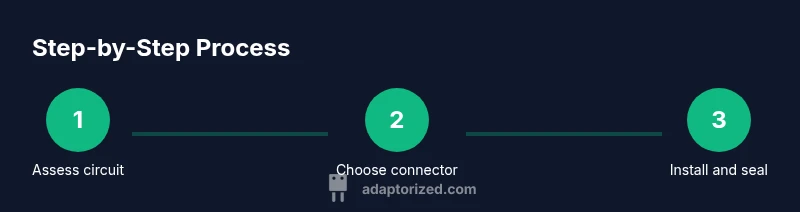
mediaPipeline":{"heroTask":{"stockQuery":"Under-hood car wiring connectors","overlayTitle":"Car Wire Connectors","badgeText":"2026 Guide","overlayTheme":"dark"},"infographicTask":{"type":"process","htmlContent":"<div class="w-[800px] p-8 bg-slate-900 text-white"><h3 class="text-2xl font-bold mb-4">Step-by-Step Process</h3><div class="flex items-center justify-between"><div class="flex flex-col items-center"><div class="w-16 h-16 rounded-full bg-emerald-500 flex items-center justify-center text-2xl font-bold text-white">1</div><div class="mt-2 text-center text-white text-sm">Assess circuit</div></div><div class="flex-1 h-1 bg-emerald-500/30 mx-2"></div><div class="flex flex-col items-center"><div class="w-16 h-16 rounded-full bg-emerald-500 flex items-center justify-center text-2xl font-bold text-white">2</div><div class="mt-2 text-center text-white text-sm">Choose connector</div></div><div class="flex-1 h-1 bg-emerald-500/30 mx-2"></div><div class="flex flex-col items-center"><div class="w-16 h-16 rounded-full bg-emerald-500 flex items-center justify-center text-2xl font-bold text-white">3</div><div class="mt-2 text-center text-white text-sm">Install and seal</div></div></div></div>","altText":"Three-step process for installing automotive wire connectors","caption":"Process flow for car wire connector installation"}},
taxonomy":{"categorySlug":"car-connectors","tagSlugs":["crimp-connector","electrical-connector","splice-connector","push-in-connector","crimping-tool"]}}}]}]} } } }]}] }}}}json_user_missing_fields_placeholder
]}]} }]}
] }]}
}
Tools & Materials
- Wire stripper(Should strip to expose conductor without nicking insulation; use a stripper with adjustable gauge allowance.)
- Crimping tool(Use a ratcheting, temperature-rated tool that matches the connector type (isolated vs uninsulated).)
- Assorted crimp sleeves and connectors(Have a range of sizes to match common automotive wire gauges (e.g., 18-22 AWG; verify with wire catalog).)
- Heat shrink tubing(Choose heat-shrink with proper wall thickness and adhesive lining for sealing.)
- Electrical tape(Use sparingly for secondary insulation and bundling but not as the primary seal.)
- Multimeter(For continuity tests and basic resistance checks; include a current-capacity test if needed.)
- Heat gun(Required only if you plan to use heat-shrink tubing with adhesive lining.)
- New connectors (sealed if external environment)(Select sealed or weather-pack variants for exterior/under-hood use.)
Steps
Estimated time: 45-60 minutes
- 1
Assess the circuit and locate the damaged connector
Power down the vehicle and inspect the harness to identify the exact connector and any signs of corrosion, cracks, or moisture. Confirm the circuit’s purpose (lighting, sensors, or power) to guide your replacement choice. Take photos for reference before disassembly.
Tip: Document the connector orientation with a quick photo log to ensure correct reassembly. - 2
Select the right replacement connector
Choose a connector that matches the existing wire gauge, terminal count, and environmental rating. If the original is sealed or weather-pack, select the same type to maintain moisture resistance. Ensure the replacement has compatible locking mechanisms.
Tip: Avoid cheap generic options; a proper automotive connector seal is essential. - 3
Prepare wires and cut if necessary
If wires are damaged, cut back to clean copper and strip the insulation to the appropriate length using a stripper. Avoid nicking the conductor, as that can create weak points. Maintain equal exposed length on each side for a clean crimp or insertion.
Tip: Keep stripped ends straight and parallel for reliable connection. - 4
Attach terminals and seal the joint
Crimp or insert the wires into the new connector according to its design. Use heat-shrink tubing around the joint and, if applicable, apply adhesive-lined shrink to seal against moisture and vibration. Ensure the connection sits fully into the harness housing.
Tip: Check for secure seating with a light tug test. - 5
Test continuity before powering up
Before reconnecting the battery, use a multimeter to verify continuity across the new joint and ensure no short to ground. If your continuity check fails, re-check the crimping and seating of the terminals.
Tip: A quick resistance check can save hours of troubleshooting later. - 6
Reconnect power and function test
Reconnect the vehicle battery and test the circuit function (lights, sensors, etc.). Look for smooth operation and verify that there is no unusual warmth at the joint after a short run.
Tip: If any heat or sparking occurs, power down and re-inspect the connection immediately. - 7
Document and tidy up
Record the replacement in the vehicle’s service log and store extra seals and connectors for future maintenance. Tidy wiring with proper routing and strain relief to prevent future failures.
Tip: Label the connector region to ease future diagnostics.
Your Questions Answered
What is the difference between crimp and push-in automotive connectors?
Crimp connectors form a permanent joint when compressed with a crimp tool, providing strong mechanical and electrical contact. Push-in connectors are quicker to install but may be less durable in high-vibration environments unless they are designed for automotive use. Your choice should reflect environment, serviceability, and reliability needs.
Crimped joints last longer in cars; push-in is faster but may not handle heavy vibration as well.
When should I use sealed connectors in a car wiring project?
Sealed connectors are recommended for any outside or under-hood wiring where moisture, dust, or temperature swings are likely. They help prevent corrosion and intermittent failures by keeping moisture away from the contact area.
Seal connectors for exterior areas to prevent corrosion.
Do I need special tools to replace automotive connectors?
A quality crimping tool, wire strippers, heat-shrink tubing, and a multimeter are typically enough for most tasks. For sealed connectors, ensure you have appropriate tools to handle the seals without damaging them.
Standard tools cover most tasks; sealed connectors may need careful handling.
How can I verify the repair is reliable after installation?
Test continuity with a multimeter, run a functional check for the circuit, and inspect the joint for gaps or exposed conductor. A temperature check after a short run helps confirm there’s no heat buildup at the joint.
Test continuity and function; check for heat after use.
Are there safety considerations unique to under-hood wiring?
Yes. Under-hood wiring is exposed to higher temperatures, chemical exposure, and vibration. Use temperature-rated, sealed connections and ensure there is no interfering routing with moving parts or hoses.
Seal and route carefully to avoid heat and abrasion.
Watch Video
What to Remember
- Match connector type to environment and wire gauge
- Use proper tooling to ensure durable, safe joints
- Seal and strain-relieve every exterior/under-hood connection
- Verify continuity and operation before closing up
- Document replacements for future maintenance