Which plug for Thailand: Outlets, voltage, and adapters explained
Plan your Thailand trip confidently by understanding plug types, voltage, and adapters. This practical guide helps travelers stay powered safely with the right equipment.


Thailand’s power standards at a glance
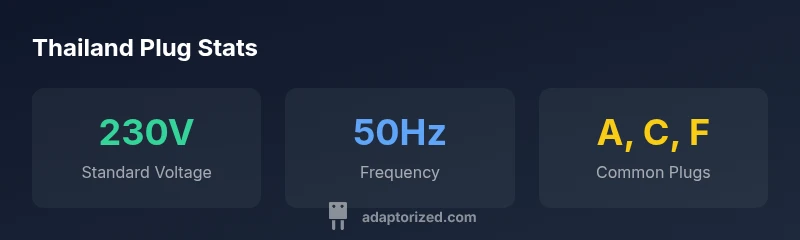
Thailand operates on a 230V, 50Hz electrical system. In urban hotels and public spaces, outlets commonly support Type A (two flat blades) and Type C (two round pins), while newer buildings increasingly install Type F (Schuko-style) receptacles. Grounded outlets (Type B or Type F with grounding) are typical for higher-wattage devices, but many older sites still rely on two-prong sockets. The practical takeaway for travelers is to assume a mixed environment: carry a universal adapter and verify your devices’ voltage. This awareness reduces the risk of dead devices and unsafe connections during a busy travel schedule.
According to Adaptorized, you should not assume uniformity from hostel to hotel; a hotel’s power setup can vary by room and building age. Always test a charger before heavy use, and don’t rely on a single outlet for all devices when you have a busy day ahead.
Common outlet types you’ll encounter in Thailand
In most rooms you’ll encounter Type A and Type C sockets. Type A is a pair of flat blades; Type C uses two rounded pins. Type F sockets (Schuko) appear in newer venues and harmonize with many European plugs; some outlets are hybrid, accepting A/C or F devices with proper insertion depth. Type B (three-prong) is far less common but can show up in certain hotel rooms or dedicated appliances. You might also run into unusual or country-specific adapters in older hostels. The main implication for travelers is that a single universal adapter can handle most cases, but you should test each device before relying on it in a busy day of sightseeing. Always check your charger’s label for voltage range and compatibility with 230V 50Hz.
Hotels that cater to international travelers often equip rooms with multiple outlet types, and in some venues you’ll find USB-enabled ports built into the wall; while convenient, these may be limited in power for high-wattage devices.
Choosing the right adapter: universal vs targeted
Travel adapters come in two broad flavors: universal, which covers multiple plug styles, and targeted, designed for a country mix. For Thailand, a good universal travel adapter with built-in surge protection and voltage compatibility is usually sufficient for most devices. If you own high-wattage appliances like hair dryers or curling irons, ensure the adapter supports their wattage load and consider a compact voltage converter only if your device is not dual-voltage. A device that is 100-240V can run safely on 230V via the adapter; a non-dual-voltage device requires a transformer. Prefer adapters with USB ports to simplify charging multiple devices at once.
When shopping, look for 2.4A or higher USB ports and a robust build that can handle frequent plug-in/out without loosening.
Voltage compatibility for devices: when you need a converter
Most modern chargers are dual voltage (100-240V). If your device is rated only for 110-120V, you’ll need a step-down converter to avoid damage. Read the label on your device’s charger: if it says “INPUT: 100-240V,” you can plug it directly into 230V with a standard adapter. For devices with motors or heating elements, a transformer that handles the wattage is necessary. Keep in mind that converters add bulk and heat; use them only where necessary and unplug when not in use.
For laptops and camera chargers, often a 65W–90W adapter suffices; phones and tablets typically draw far less current, which a compact adapter can handle.
Practical packing checklist for travelers
- Universal travel adapter with spare USB-C and USB-A ports
- Voltage converter only if your device isn’t dual-voltage
- Documentation of voltage requirements for devices
- A compact surge protector to share a single outlet safely
- A portable power bank for USB devices
- Mini flashlight for power outages or dark hotel rooms
Packing smart reduces the chance of scrambling at check-in or during a layover.
Hotel and airport outlet realities
Hotels typically mix A, C, and sometimes F outlets; newer properties may emphasize EU-style outlets while budget rooms might be older-style two-prong sockets. Airports and lounges often provide USB-C/USB-A charging stations, but wall outlets might be scarce in busy terminals. Always carry your own adapter, confirm the room’s outlets upon check-in, and avoid overloading a single surge protector with high-wattage devices. When in doubt, ask hotel staff which outlets are safe for charging high-wattage gear.
Step-by-step: using a travel converter safely
- Verify device voltage on the charger label (230V in Thailand). 2) Plug in the correct plug adapter for Type A, C, or F outlets. 3) Connect to a grounded outlet if possible. 4) Start with a low-power device to test. 5) Monitor for excessive warmth and unplug if anything smells odd. 6) Store converters when not in use to avoid overheating in bags.
Common mistakes to avoid
- Assuming all outlets are the same across all hotels and regions in Thailand.
- Using non-dual-voltage devices without a transformer.
- Relying on a power strip for high-wattage appliances.
- Ignoring grounding and fusing when using external adapters.
- Forgetting to bring adequate USB charging options for mobile devices.