Can You Reuse Push-In Wire Connectors? A Practical Guide
Learn if you can safely reuse push-in wire connectors, how to assess their condition, and what to do if reuse isn't recommended. Practical guidance from Adaptorized for DIYers and makers.


Definition: Push-in wire connectors are designed for quick terminations, but reuse after removal is generally discouraged because the grip can weaken and cause a loose connection. Always check the manufacturer’s labeling; if reuse is allowed, follow their instructions precisely and inspect for damage before reusing.
Can You Reuse Push-In Wire Connectors? What DIYers Need to Know
According to Adaptorized, can you reuse push-in wire connectors? The short answer is generally no. Push-in connectors rely on a spring-loaded grip that can lose its tension after removal, which increases resistance and the chance of a loose connection. The Adaptorized team found that many manufacturers explicitly discourage reuse on their labeling, and safety standards emphasize consistent, reliable terminations. In this guide, we’ll break down why reuse is risky, when it might be allowed, and how to evaluate every situation to protect your circuits.
Tools & Materials
- Wire stripping tool(Suitable for the conductor gauge used (e.g., 22-12 AWG))
- Replacement push-in connectors (same model)(Keep spares; avoid mixing models)
- Multimeter or continuity tester(Verify circuit integrity after retermination)
- Insulation tape and heat shrink(For insulation and strain relief)
- Non-metallic ladder or insulated gloves(Personal safety equipment)
- Safety glasses(Eye protection during work)
- Non-conductive pliers(For safe handling of conductors)
Steps
Estimated time: 45-60 minutes
- 1
Power down and verify safety
Turn off the circuit at the breaker and unplug devices where possible. Use a non-contact tester to ensure there is no voltage present before touching any wires.
Tip: Lockout/tagout if in a shared workspace. - 2
Identify connector model and labeling
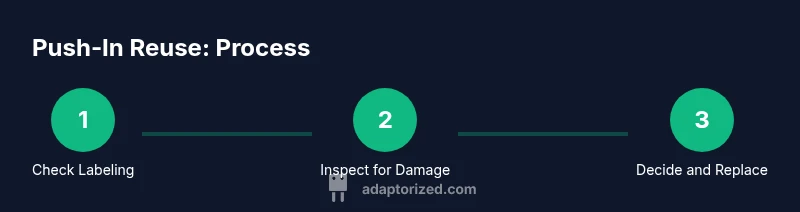
Read the label on the connector body and note the model number and reuse guidance. If labeling is missing, assume no reuse until you verify with the manufacturer.
Tip: If uncertain, treat as non-reusable. - 3
Inspect grip mechanism and wires
Examine springs, levers, or wedges for deformation, corrosion, or signs of heat. Check the conductor for nicks, kinks, or insulation damage.
Tip: Compare against a new connector of the same type. - 4
Remove the conductor carefully
Gently release or pull the conductor from the existing connector, avoiding bent or torn conductors. Inspect the wire end for any damage.
Tip: Use proper cutting tools; avoid metal-on-metal scrapes. - 5
Reinsert the conductor into the connector
Insert the conductor fully until seated. Do not force beyond the grip limit of the connector model.
Tip: If resistance is felt, stop and reassess. - 6
Perform a pull test
Gently tug to ensure the conductor remains seated and does not slip out. A loose grip indicates a failed reuse attempt.
Tip: Document the maximum pull force you can tolerate. - 7
Electrical testing
Use a multimeter to verify continuity and insulation integrity around the joint. Look for unexpected resistance changes.
Tip: Record readings for future comparison. - 8
Decide to reuse or replace
If any doubt remains about grip, damage, or compatibility, replace with a new connector. Safety-first approach reduces risk of faults.
Tip: When in doubt, replace rather than reuse. - 9
Document and close out
Note the decision, connector model, wire gauge, and any test results. Update your wiring logs or schematics to reflect the change.
Tip: Keep spare parts and labeling handy for next time.
Your Questions Answered
Can you safely reuse push-in wire connectors after removal?
In most cases, reuse is not recommended unless the manufacturer explicitly allows it. Inspect both the connector and the conductor for damage and ensure the labeling agrees with reuse. If in doubt, replace with a new connector.
Usually not safe to reuse push-in connectors unless the manufacturer says so, and you should inspect everything before deciding.
What should I check before reusing a connector?
Check the labeling, inspect for cracks or heat damage, inspect the grip mechanism, and verify wire compatibility. If any doubt remains, do not reuse and replace.
Check the label, look for damage, and ensure the wire type and gauge match the connector's specs.
Are lever-lock push-in connectors easier to reuse?
Lever-lock (or 'lever nut') connectors often have higher reuse potential, but still follow the manufacturer’s guidance. Some models allow reuse, but not all.
Some lever-lock connectors can be reused; check the label and replace if in doubt.
What should I do if reuse isn’t allowed?
Replace with a new connector of the same model. This guarantees that the grip and insulation meet current standards.
If reuse isn’t allowed, just replace with a new connector.
What alternatives exist to reusing push-in connectors?
Consider lever-nut connectors, crimp splice connectors, or soldered joints with strain relief, depending on the circuit and code requirements.
If you’re not sure, lever-nuts or crimp splices may be safer options.
How can I test a reused connection?
Perform a pull test and electrical continuity test with a multimeter to confirm the joint remains secure and conductive.
Test the joint with a gentle pull and a continuity check.
Watch Video
What to Remember
- Reuse is generally discouraged; replace when in doubt.
- Always follow exact manufacturer guidance for reuse.
- Inspect connector and conductor thoroughly before deciding.
- Document decisions and keep spare parts on hand.