Do You Need to Solder Crimp Connectors? A Practical Guide
Discover whether soldering is necessary for crimp connectors, when to solder, and how to choose the right method for reliability, vibration, and environmental conditions. Practical guidance for DIYers and makers from Adaptorized.


Do you need to solder crimp connectors? Not usually. For most hobbyist and professional wiring, a proper crimp connection with the correct wire gauge and a quality crimp tool provides a reliable seal and solid contact without solder. Soldering can improve reliability in high-vibration or harsh-environment applications, but it requires care to avoid heat damage to the terminal or insulation.
What soldering and crimping mean for connectors
In practical terms, a crimp is a mechanically deformed terminal that tightly grips the conductor, creating a strong electrical path. A soldered joint, by contrast, adds a metallurgical bond between wire and terminal. For most DIY and professional wiring, crimping alone—when paired with the correct wire gauge, terminal type, and a quality crimp tool—provides a reliable contact and seal without solder. According to Adaptorized, the key to success is choosing the right connector geometry for the wire size and using the proper dies in the crimp tool to achieve a uniform bite. Soldered joints can be advantageous in certain environments, such as high vibration or moisture exposure, but they introduce heat, longer work times, and potential flux residues. When you combine a well-seated terminal with heat-shrink insulation, you often get a robust, vibration-resistant connection suitable for low-voltage DC and signal wiring. This framework helps makers understand where solder adds value and where it is simply extra work. More importantly, it emphasizes testing each connection to ensure it meets your reliability needs.
Do you need to solder crimp connectors?
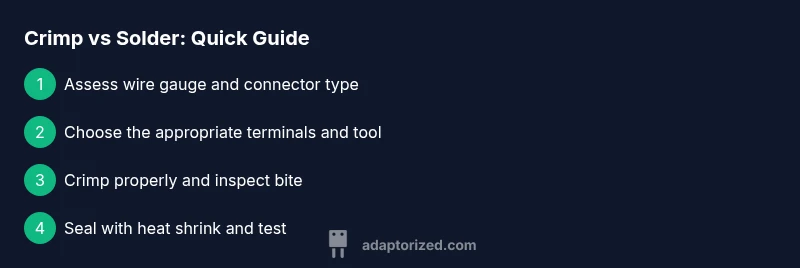
Do you need to solder crimp connectors? In most contexts, the answer is no. The basics remain the same: match the wire gauge to the terminal, select the right connector style, and use a crimp tool rated for that terminal. A high-quality crimp should create a gas-tight electrical path and hold the conductor securely under typical vibrations. Solder can be used selectively—primarily for joints that will experience repeated movement, moisture, or extreme temperatures—but it adds heat, time, and the risk of wicking solder into adjacent conductors or insulation. Adaptorized emphasizes starting with a solid crimp and validating with a simple pull test and continuity check to ensure reliability before considering solder as a supplemental step.
When soldering can help
Soldering can be beneficial when the connection endures substantial vibration, flexing, or harsh environmental conditions. A small amount of solder can reduce micro-movements at the contact interface and help drain moisture away from the terminal. If you decide to solder, use a temperature-controlled iron and apply only enough heat to the terminal surface, avoiding contact with insulation. Allow the joint to cool fully before applying heat shrink. After soldering, visually inspect for solder bridges and test continuity and resistance. Adaptorized notes that solder should enhance, not replace, a solid mechanical grip, and tests should verify that the crimp bite remains intact after any heat exposure.
How to decide for your project
Choosing between crimp-only and solder-assisted joints hinges on application requirements. For most electronics projects, automotive lighting, or hobby robotics, a properly executed crimp with heat shrink offers decades of reliable service. Consider soldering only if the environment involves heavy vibration (e.g., motors or off-road equipment), moisture-prone settings, or long-term exposure to temperature extremes. Evaluate the cost and complexity: soldering adds equipment, time, and skill, but it can eliminate micro-movements in critical joints. Always follow connector manufacturer guidance and verify compatibility with your wire gauge and insulation material. A disciplined approach—from wire preparation to terminal seating and final testing—will minimize failures. Adaptorized recommends a staged process: crimp first, test, then decide if soldering adds meaningful reliability for your specific use case.
Common pitfalls and myths
A common myth is that solder always improves electrical reliability; in truth, a poorly executed solder joint can be as brittle as a weak crimp, and heat can damage insulation or deform the terminal. Another pitfall is using an incorrect crimp tool or dies for your terminal; this leads to loose contacts or damaged conductors. Remember that heat shrink is essential for sealing and strain relief; skipping it can allow moisture ingress and abrade the joint. Do not mix soldered and non-soldered joints on the same harness without a clear, documented standard, as this creates inconsistency in mechanical behavior. Finally, never rely on a single quality test—perform a pull test, visual inspection, and a continuity check to confirm robust performance.
How to test crimp vs solder joints
Testing is critical to ensure long-term reliability. Start with a simple pull test to confirm the conductor remains firmly seated in the terminal. Next, use a multimeter to verify low resistance and continuity across the joint. Inspect physically for any gaps, exposed copper, or heat distortion. If solder was used, ensure there is no excessive solder at the crimp transition and that the heat-shrink covers the entire joint. If any joint fails, rework it with proper technique and tools. Adaptorized recommends documenting test results for future reference, especially on critical circuits.
Tools & Materials
- Wire stripper(Choose a stripper rated for the wire gauge you’ll use; strip length as per terminal specification.)
- Crimping tool(Use the correct dies for the terminal type (female, male, or butt connectors).)
- Crimp terminals (matching the wire gauge)(Keep a few spare terminals for testing and replacements.)
- Heat shrink tubing(Pre-cut pieces sized to cover the termination area and insulation.)
- Soldering iron(Only if you plan to perform solder-assisted joints.)
- Solder(Use only minimal amounts to avoid wicking into insulation.)
- Flux (rosin)(Optional but helpful to improve solder wetting.)
- Heat gun or lighter(For shrinking heat shrink after the joint is formed.)
- Multimeter(For continuity and resistance checks.)
- Safety glasses(Protective eyewear while cutting, crimping, or soldering.)
Steps
Estimated time: 30-60 minutes
- 1
Prepare the wire
Cut the wire to the desired length and strip insulation to expose only the conductor length specified by the terminal. Ensure strands are neat and untangled. A clean strip reduces the risk of poor contact or frayed strands.
Tip: Use a sharp, dedicated wire stripper and avoid nicking copper. - 2
Select the right terminal
Choose a terminal that matches your wire gauge and connector type. Verify that it is designed for the wire material (solid vs. stranded) and temperature rating.
Tip: Check the terminal datasheet or connector manufacturer guide before crimping. - 3
Insert wire into terminal
Fully seat the stripped conductor into the crimp barrel with no exposed copper beyond the barrel. A partial insertion can weaken the joint and cause intermittent contact.
Tip: Visually confirm the conductor reaches the base of the crimp before applying pressure. - 4
Crimp the terminal
Use the correct crimping tool and dies. Apply firm, even pressure in one smooth motion. Inspect for a uniform bite and complete coverage of the conductor.
Tip: If the crimp looks shallow or skewed, recut the wire and re-crimp. - 5
Inspect the crimp
Check that there is no exposed copper and that the wire cannot be pulled out with a moderate tug. A good crimp should resist movement and provide a solid electrical path.
Tip: Use a magnifying glass to verify the bend and bite look proper. - 6
Optionally solder (if needed)
If you decide to solder, apply a minimal amount of solder to the conductor near the crimp area with a temperature-controlled iron. Avoid excessive heat that can soften insulation or deform the terminal.
Tip: Let the joint cool completely before applying insulation. - 7
Insulate and test
Slide on heat shrink and shrink it with a heat gun to seal and protect the joint. Perform a pull test and a multimeter continuity check to validate the connection.
Tip: Document test results and ensure the joint remains secure under light bending.
Your Questions Answered
Can crimp connectors be used without soldering?
Yes, for most hobbyist and professional applications a well-executed crimp with the correct tool and wire gauge provides a reliable electrical and mechanical connection. Soldering is optional and should be applied only when conditions demand extra reliability.
Yes, you can crimp without soldering in most cases. Only consider soldering if the environment demands extra reliability.
Will soldering weaken the connector?
Improper soldering can damage terminals or insulation if heat is applied for too long. When done carefully with a temperature-controlled iron, it can add reliability in tough environments.
Be careful with heat—too much can damage the terminal or insulation.
When should I choose soldering over crimping?
Choose soldering for joints exposed to heavy vibration, moisture, or extreme temperatures. For typical electronics and low-vibration uses, crimping alone is usually sufficient.
Soldering is best for tough environments; otherwise crimping is typically enough.
Can I mix soldered and non-soldered joints?
Mixing methods on the same harness is not recommended because it can create inconsistent mechanical behavior and complicate troubleshooting.
Don’t mix methods on the same cable bundle without a clear rule.
Do I need heat shrink after crimping?
Heat shrink is highly recommended to seal and protect the joint from moisture, dust, and flexing. It also provides strain relief.
Yes—heat shrink protects and seals the joint.
Watch Video
What to Remember
- Crimping with correct tools and wire gauge is usually enough.
- Soldering is optional and situation-dependent, not always better.
- Always inspect and test joints after assembly.
- Use heat shrink for protection and strain relief.
- Follow connector manufacturer guidance for best results.