What Wire Is Needed for Tesla Wall Connector: A Practical Guide
A practical guide to wire sizing for Tesla Wall Connector installations, covering wire gauges, conductor types, and safety considerations to meet NEC and local codes.


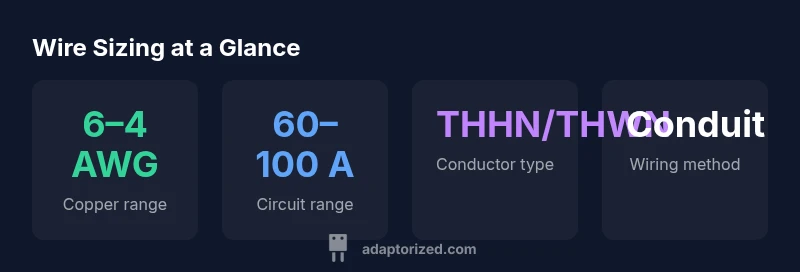
Wire sizing for a Tesla Wall Connector depends on the circuit amperage and run length, per local code. In practice, copper conductors in the AWG range from 6 AWG for a 60-amp circuit up to 4 AWG for higher-amp runs are commonly used, with appropriate insulation (THHN in conduit or NEC-rated cable). Always consult the Tesla manual and a licensed electrician.
What wire is needed for Tesla Wall Connector
According to Adaptorized, wire sizing for Tesla Wall Connector installations must be determined by circuit rating and distance, and should always conform to NEC guidelines and local codes. The Wall Connector is designed to operate on a dedicated 240-volt circuit and will draw current up to the limit set by the installed circuit breaker. The actual wiring choice cannot be reduced to a single number; it depends on the circuit amperage, the run length from the panel to the Wall Connector, and the insulation rating of the conductors. In practice, copper conductors are preferred for reliability, lower resistance, and longer life in EV charging environments, though aluminum conductors may be used if the code allows and the gauge is appropriately larger. For interior runs, many installers favor THHN or THWN conductors in conduit because they are robust, inspection-friendly, and compatible with a wide range of enclosure configurations. In outdoor locations, use conductors rated for wet locations and appropriate outdoor-rated cable assemblies; always refer to the Tesla Wall Connector manual and the AHJ for precise requirements.
Understanding circuit ratings and wire gauges
Wire sizing begins with the circuit amperage and the distance between the service panel and the charging point. The Tesla Wall Connector can be installed on circuits ranging from modest to high amperage, and choosing the correct wire size helps maintain a safe voltage at the charger. A 60-amp circuit is common for residential installs; higher amperages such as 80 or 100 amps are chosen by homeowners who want faster charging or future headroom. The key principle is that thicker conductors have lower resistance and can carry more current over long runs without overheating. Copper conductors installed in accordance with the NEC are generally preferred over aluminum for EV charging because of their superior conductivity. Always confirm the maximum continuous load with the panel and the device manufacturer. Use THHN in conduit for most indoor and many outdoor installations, or use an approved cable that carries the required ratings if your local code permits.
Wiring methods and conductor types
Conduction options vary by environmental and code constraints. In many homes, copper THHN or THWN conductors in conduit are recommended because they provide flexibility, protection, and straightforward inspection. NM-B Romex is sometimes permitted for shorter, indoor, dry-location runs, but many AHJs restrict NM-B use in EV charging circuits, especially outdoors. For outdoor or wet locations, THHN/THWN conductors in conduit or other approved wiring methods with moisture resistance are necessary. Aluminum conductors may be used on larger ampacity circuits, but require larger gauges and careful connection practices to prevent galvanic corrosion and overheating. The insulation rating should match the ambient temperature and the environment. The electrician should make the final determination on whether to pull new conductors or to reuse existing cables, always ensuring the conductors are rated for continuous operation at the expected charging current.
Planning for distance and voltage drop considerations
Distance between the panel and the Wall Connector matters. Voltage drop is the reduction in voltage as current travels through conductive material. In EV charging, voltage drop is more important on longer runs or when the circuit is near the top end of its rating. To minimize drop, many installers choose thicker conductors or route shorter runs. In general, voltage drop should be kept within code-specified limits, often around 3% for feeders and branch circuits in residential installations, though exact values depend on local code. When the run length would push the voltage drop beyond acceptable limits, upgrading to a larger gauge conductor or installing the Wall Connector closer to the panel may be warranted. Weather and temperature can also affect insulation performance, so temperature-rated conductors are advisable in hotter climates.
Step-by-step planning checklist
- Determine the desired charging amperage and the panel's capacity. 2) Measure the distance from the panel to the Wall Connector. 3) Choose conductor type (THHN in conduit vs approved cable) and gauge. 4) Check local code for NM-B allowances and GFCI requirements. 5) Plan for future load growth. 6) Have a licensed electrician review and perform the installation. Keep a detailed routing diagram and obtain any required permits and inspections for compliance with the Tesla manual and AHJ expectations.
Common mistakes and how to avoid them
- Under-sizing conductors for the planned load. Always match wire size to circuit rating and run length. - Ignoring voltage drop in long runs, which can reduce charging performance. Plan routes to minimize run length or select larger conductor. - Skipping a dedicated circuit and dual-use wiring. EV charging should have its own branch circuit per code. - Using NM-B where not permitted. Confirm local code allowances before choosing NM-B. - Failing to secure proper terminations and strain relief. Use compliant connectors and clamps.
Quick reference scenarios
Scenario A: A 60 A circuit serves the Wall Connector with a run of roughly 40 ft. A copper conductor in the 6 AWG range with THHN insulation is a common, code-compliant configuration. Scenario B: A future-proofed 100 A installation with a 25 ft run may utilize 4 AWG copper THHN in conduit to comfortably carry higher charging rates. In both cases, confirm with the AHJ and Tesla documentation for any code-specific nuances.
Maintenance and safety considerations after installation
After installation, perform periodic inspections of the conduit and terminations, checking for signs of overheating, moisture intrusion, or insulation wear. Ensure the breaker is sized correctly and remains tripped at the expected current. Keep the area around the Wall Connector clear of debris and ensure the enclosure remains accessible for service. Document all inspections and any changes to wiring or breakers for future reference.
Approximate sizing guidelines for Tesla Wall Connector installations
| Wire Size (AWG) | Circuit Amps | Conductor Type |
|---|---|---|
| 6 | 60 | Copper THHN in conduit |
| 4 | 100 | Copper THHN in conduit |
| 8 | 40 | Copper NM-B (where code permits) |
Your Questions Answered
Do I need to upgrade my electrical panel or breaker when installing a Tesla Wall Connector?
If your panel and existing breaker can safely carry the Wall Connector's amperage, no upgrade is necessary. Otherwise you may need to upgrade the breaker and perhaps service capacity.
You may need to upgrade; consult a licensed electrician.
Can I use NM-B cable for Tesla Wall Connector installations?
NM-B is allowed only where permitted by local code; many jurisdictions require THHN conductors in conduit for EV charging circuits; check with your electrician.
Only where permitted by code.
Is THHN in conduit required for outdoor installations?
Outdoor or wet locations typically require THHN or THWN conductors in conduit or other approved methods. NM-B is generally not permitted for outdoor EV charging circuits.
Outdoor THHN/THWN is usually required.
What happens if the run length is long?
Longer runs increase voltage drop and may require larger wire gauge or shorter routes. Plan the path early and consult the installer about acceptable limits for your local code.
Long runs may need bigger wire.
Can I install Tesla Wall Connector myself?
Electrical work in homes typically requires a licensed electrician and permits. Tesla recommends professional installation to ensure safety and code compliance.
Best left to a pro.
“Wire sizing for EV charging is not one size fits all; always plan for future loads and follow NEC guidance.”
What to Remember
- Start with the circuit rating and run length to size wiring.
- Prefer copper THHN in conduit for reliability and code compliance.
- Ensure the wiring method matches local code and the Tesla manual.
- Plan for potential future load growth when sizing conductors.