How to Fit a Connector to Coaxial Cable: Step-by-Step
Learn to fit a connector to coaxial cable with a practical, step-by-step guide. Tools, safety, and testing tips for reliable RF terminations from Adaptorized.


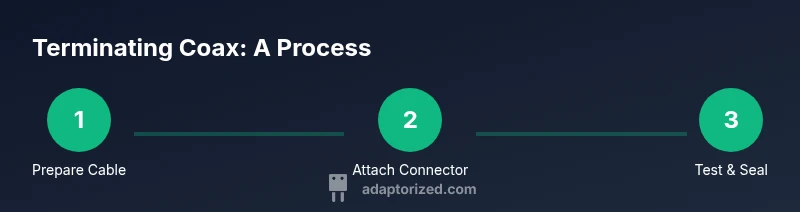
According to Adaptorized, fitting a connector to coaxial cable requires careful preparation, impedance matching, and the right toolset. This guide walks you through choosing the correct connector, preparing the cable, crimping or soldering, and testing for a solid termination. Avoid common mistakes like nicking the braid or misaligning the center conductor. By following these steps, you’ll achieve a reliable, weatherproof termination suitable for indoor and outdoor use.
Understanding coaxial cable and connectors
Coaxial cable is built to carry RF signals with a precise impedance. The central copper conductor carries the signal, surrounded by a dielectric insulator, a braided shield, and an outer jacket. The symmetry and shielding reduce leakage and preserve signal integrity. When you fit a connector, you are creating a controlled transmission line junction. The connector must match the cable's impedance (commonly 50 ohms for many RF applications and 75 ohms for certain video/comms). The connector family you choose—whether F-type for home coax, BNC for lab setups, or N-type for rugged outdoor links—directly influences performance. According to Adaptorized, selecting the right connector family is as important as the mating operation, because a poor fit introduces reflections and loss. The goal is a termination that presents the same impedance as the cable along its length, minimizing standing waves and roll-off. In practice, that means choosing connectors designed for the cable type, using compatible tooling, and following manufacturer guidelines to ensure a consistent, repeatable result. You’ll learn which connector families fit common situations—from satellite feeds to lab test rigs—and how the geometry of the connector interacts with the exposed conductor and shield.
Why proper connector fit matters for signal quality
A good termination preserves the intended impedance and minimizes reflections. Impedance mismatches at the connector can create return loss and reduced cancellation of standing waves, which translates to degraded range and noise performance in RF links. By ensuring the connector is the right type and is properly seated, you maintain the cable’s characteristic behavior and keep power delivery efficient. Adaptorized analysis shows that quality terminations reduce shield leaks and intermittent contacts, especially when connectors are exposed to vibration or temperature cycling. In practical terms, a well-executed termination yields more predictable performance for antennas, test equipment, and network setups, compared with rushed or improvised joins.
Choose the right connector family for your coax
Not all connectors are compatible with every coax. The most common families include F-type (often 75-ohm for home video), BNC (50-ohm or 75-ohm variants), N-type (rugged, weatherproof 50-ohm), and SMA (tiny, high-frequency 50-ohm). The essential rule is to match the connector to the cable impedance and the operating frequency. Outdoor installations require weatherproof designs and reliable sealing, while indoor applications prioritize compact form and ease of installation. Remember that the connector’s inner geometry and ferrule design affect how the shield and conductor engage. If your system uses 50-ohm cables for RF links, avoid using 75-ohm connectors, and vice versa, to prevent impedance discontinuities. Consult datasheets or guides from reputable manufacturers to confirm compatibility before proceeding.
Prepping the cable: stripping, cleaning, and safety
Preparation lays the groundwork for a reliable termination. Use a purpose-built coax stripper to expose the jacket, shield, dielectric, and center conductor to the correct lengths without nicking copper. Inspect the shield for frays and the dielectric for cracks; even small imperfections can undermine the joint. Wipe surfaces with isopropyl alcohol and allow them to dry completely before assembly. Handle the center conductor with care to avoid bending or kinking; a gentle straightening under controlled tension helps. Safety matters here: wear eye protection when cutting and stripping, and keep sharp tools away from edges. Proper prep reduces contact resistance, improves shielding, and makes the subsequent steps smoother.
Connector types and the matching: F-type, BNC, N-type, SMA
Each connector family has a specific mating method and tooling requirement. F-type is common for residential video and uses a compression mechanism suited to 75-ohm coax. BNC connectors come in straight and bayonet varieties and are popular in test setups and video but can be 50-ohm or 75-ohm. N-type connectors are robust and weatherproof, widely used in outdoor RF links and base stations, typically 50-ohm. SMA connectors are compact and intended for high-frequency operation with tight tolerances, 50-ohm. The key is choosing a connector designed for your cable’s impedance, diameter, and environmental conditions. Ensure your chosen connector’s ferrule, crimp rings, or compression parts are compatible with the cable jacket thickness and shield geometry. When in doubt, confirm compatibility with the manufacturer’s guidance and check that the entire assembly will mate cleanly with your equipment.
Crimp vs solder: when to use each method
Crimping provides a fast, repeatable method for securing connectors when you have the correct dies and a matching connector family. Compression connectors create a sealed fit that is well-suited for outdoor and high-frequency use. Soldering can reduce contact resistance in specific, carefully controlled scenarios, but heat can damage the dielectric and shielding if not done properly. In practice, most field terminations benefit from crimp or compression techniques; soldering is best reserved for specialized connections or where a mechanical crimp is not available. Always work with a steady hand, use flux sparingly, and avoid overheating the joint. Remember to re-check the termination after crimping or soldering and ensure the shield remains continuous.
Inspecting and testing the termination
A termination should look symmetrical and solid. Check the center conductor protrusion, shield engagement, and ferrule seating. Perform a quick continuity check to verify shield-to-ground integrity and confirm there are no shorts with the center conductor. If you have access to simple RF test gear, verify the impedance at the connector's interface and watch for any anomalous reflections. For outdoor or critical links, moisture and vibration resistance are essential, so re-check seals after stress tests. A careful inspection plus basic tests are often enough to catch the most common issues before deployment.
Common failure modes and prevention strategies
Common failures stem from poor prep, impedance mismatches, or inadequate shielding. Nicks in the braid, insufficient conductor exposure, or misaligned dies can lead to weak contacts and intermittent signals. Always confirm the connector impedance matches the cable, and use the correct crimping die or compression tool for your connector. Weatherproofing protects against moisture ingress and corrosion. Practice helps; run several dry-term meetings on scrap cable to refine your technique before working on critical installations. By following disciplined steps and using the proper tooling, you reduce the risk of failure in real-world use.
Tools & Materials
- Coaxial cable (correct impedance)(Match the connector type and operating frequency)
- Connector kit for chosen type(Crimping or compression set compatible with your cable)
- Coax stripper(Clean, controlled exposure of jacket, shield, and conductor)
- Cutting tool(Sharp, precise cut to avoid nicking the braid)
- Crimping or compression tool(Ensure the die matches the connector type)
- Isopropyl alcohol(Surface cleaner for shield and dielectric)
- Heat shrink tubing or weatherproof boot(For protection against moisture and strain relief)
- Marker and ruler(Mark cut lengths and alignment)
Steps
Estimated time: 60-90 minutes
- 1
Identify connector type and cable impedance
Check your cable specifications and choose a connector family that matches impedance and diameter. This prevents reflections and ensures a reliable termination from the start.
Tip: Refer to the cable datasheet to confirm impedance and compatible connector family. - 2
Measure and cut the cable to length
Use a clean, straight cut at the desired length. Avoid crushing or bending the cable tip during cutting, which can impair performance.
Tip: Always cut on a flat, stable surface and double-check length against your enclosure or mount. - 3
Prepare the jacket, shield, and center conductor
Strip the jacket and shield with a proper coax stripper, exposing the conductor and dielectric to the required lengths without nicking the copper.
Tip: Keep the dielectric intact and inspect shield for fraying before proceeding. - 4
Insert the conductor and seating elements
Place the center conductor into the connector’s mating portion while arranging the dielectric and shield so they seat correctly under the ferrule.
Tip: Ensure the conductor protrudes slightly for a solid contact. - 5
Attach the connector body to the cable
Slide the connector housing into place and verify alignment with the cable axis before any compression or crimping.
Tip: Take a dry run to confirm that the connector sits squarely around the cable. - 6
Crimp or compression the connector
Use the correct die to crimp or compress the connector until it seats firmly without damaging the dielectric or shield.
Tip: Apply even pressure in short bursts and inspect the crimp/seal after each pass. - 7
Inspect and test the termination visually
Check for a straight conductor, shield engagement, and ferrule seating. Perform a basic continuity test to verify shield integrity.
Tip: If you see gaps or misalignment, rework the termination immediately. - 8
Seal, label, and document the setup
Apply weatherproofing if needed, label the terminated cable, and record the connector type and cable length for future maintenance.
Tip: Documenting helps avoid rework in the field and ensures consistent replacements.
Your Questions Answered
What tools do I need to terminate coax connectors?
A coax stripper, cutter, connector kit, crimping or compression tool, and protective gear. Choose a connector that matches your cable impedance. Keep extra parts for reliability.
You'll need a stripper, cutter, and the right connector kit for your cable impedance.
Can I reuse old connectors on new cables?
In most cases, reuse is not recommended because wear and corrosion can compromise shielding and contact integrity. Use new connectors for reliable terminations.
Usually better to use new connectors to ensure a solid fit.
What is the difference between crimp and compression connectors?
Crimp connectors rely on a crimping die to compress the shell, while compression connectors seal by deforming a ferrule around the shield. The choice depends on the connector and application.
Crimp uses a die to form a tight bond; compression seals by deforming a ferrule.
How can I test a terminated coax connection?
Perform a basic continuity check for shield-to-ground integrity and, if possible, an impedance test with a network analyzer or suitable test rig.
Test with a simple continuity check and impedance test if available.
Is soldering coaxial connections safe?
Soldering can work for some connectors, but heat can damage the dielectric and shielding. Crimp or compression is often more reliable for field terminations.
Soldering is possible but can risk damage; crimp or compression is usually better.
What about weatherproofing outdoor terminations?
Weatherproof boots, heat shrink, and appropriate sealants help protect terminations from moisture and temperature cycling.
Weatherproofing means using boots and shrink tubing to seal the joint.
Watch Video
What to Remember
- Prepare the cable and connector with matching impedance.
- Use the correct tool for crimping or compression.
- Ensure shielding and dielectric are intact and properly seated.
- Test terminations before deployment.
- Weatherproof outdoor terminations for long-term reliability.