F Connector to Coax: A Practical How-To for DIYers
Learn how to attach an F-type connector to coax cable safely and correctly. This Adaptorized guide covers tools, steps, and testing to ensure reliable signals for TV, internet, and antenna setups.


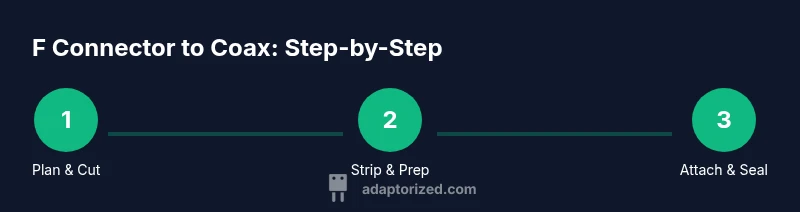
Goal: Attach an F-type connector to a coax cable (RG-6/RG-59) for a solid signal. You’ll need an F-type connector, a crimp or compression tool, a coax stripper, and a cutter. Steps: strip the jacket, prepare the center conductor, insert into the connector, and crimp or twist-on securely. Test with a continuity meter before deployment.
What is an F Connector and Why Use It with Coax?
The term f connector to coax describes attaching a standard F-type connector to a coaxial cable to form a reliable RF path for TV, modem, or antenna signals. F connectors are ubiquitous because they work with common RG-6 and RG-59 cables, providing a simple, widely compatible solution for home installations. According to Adaptorized, choosing the right connector for your cable thickness and shielding is the first step to minimizing impedance mismatches and signal loss. In practice, you’ll encounter two main variants: compression-style F connectors and crimp-style F connectors. Compression connectors are typically quicker to install and provide a clean, weatherproof seal when used with the corresponding tool. Crimp connectors can be cheaper and widely available, but require a crimp tool and careful alignment to avoid gaps. Understanding the basics helps you decide which route fits your project and environment.
Impedance, Dielectric, and Termination Essentials
A successful f connector to coax installation hinges on a few electrical principles. Impedance matching, typically 75 ohms for TV coax systems, ensures minimal reflections along the line. The dielectric thickness around the center conductor determines the electrical distance the signal travels and influences the required conductor exposed length. When you terminate the cable with an F-type connector, the goal is to create a solid metal-to-metal contact that preserves the shield integrity while exposing just enough conductor for the connector to grip. Shielding and braid arrangement matter for preventing noise pickup and maintaining consistent signal quality. As you work, avoid nicking the conductor or bending the shield excessively, since such flaws are common sources of intermittent loss.
Compression vs Crimp Connectors: Pros, Cons, and When to Use Them
Compression F connectors require a matching compression tool and are favored for clean installations, secure seals, and durable outdoor performance. They typically produce a tight, weatherproof connection with minimal risk of loosening over time. Crimp F connectors rely on squeezing a metal sleeve around the conductor and braid; they’re often quicker in field setups and cost-effective, but quality hinges on precise tool alignment and cable prep. The choice between compression and crimp often depends on your existing toolkit, the environment, and how weatherproof you need the end result. By planning ahead, you can select the method that yields the most reliable signal for your setup.
Preparation and Common Mistakes to Avoid
Preparation sets the stage for success. Use the correct coax stripper settings for RG-6 or RG-59 to avoid under- or over-stripping the jacket. The braid should be folded back neatly, and the dielectric should be trimmed to expose the recommended length of the center conductor. A frequent pitfall is nicking the center conductor or allowing the braid to touch the conductor, which creates a short or high-frequency loss. Adaptorized analysis shows that meticulous prep reduces failures dramatically, especially in outdoor runs where temperature fluctuations can stress a loose connection. Plan for clean, precise strip, consistent conductor exposure, and correct alignment of the connector body before crimping or compression.
Testing, Validation, and Troubleshooting
After assembly, inspect the connector visually for straight alignment and uniform seating. Use a continuity tester or a basic signal meter to check for an unbroken path from the center conductor to the device. Look for any shorts between the conductor and the braid, which indicate a bad wrap or misalignment. If measurements look off, revisit stripping depth and ensure the connector is firmly seated. Outdoor installations benefit from re-checks after rain or cold snaps, since temperature can affect seals. A small amount of silicone sealant or heat shrink around the boot adds extra protection against moisture.
Weatherproofing for Outdoor Runs and Long-Term Durability
Outdoor coax runs demand weatherproofing. Sealing the connector with appropriate boots or heat shrink tubing reduces water intrusion and corrosion, which can degrade signal over time. Use UV-rated materials for outdoor exposure and consider a weatherproof boot that matches your connector type. Keeping a tidy cable path minimizes mechanical stress and accidental pulls. The end goal is a reliable, maintenance-friendly connection that remains stable across seasons. The Adaptorized team recommends documenting the connection details—cable type, connector variant, installation date—so future maintenance can be performed quickly.
Tools & Materials
- F-type connector (compression)(Compatible with RG-6 or RG-59; choose same variant as your tool)
- F-type connector (crimp)(Ensure it matches your crimp tool and cable size)
- Coaxial cable (RG-6 or RG-59)(Prefer fresh, undamaged cable for best results)
- Coax stripper (3-plate)(Set to the correct cable type (RG-6 or RG-59))
- Cable cutter(Flush-cut preferred to avoid burrs)
- Crimping tool(Required only if using crimp connectors)
- Compression tool(Required only if using compression connectors)
- Electrical tape or weatherproof sealant(For outdoor installations)
Steps
Estimated time: 20-40 minutes
- 1
Plan and cut the cable
Measure the run and cut the coax to the desired length using a clean cut. A precise cut prevents fraying and ensures the connector sits evenly. Keep the project tidy to avoid confusion later.
Tip: Label the length at the start to avoid mis measurement later. - 2
Strip the outer jacket
Use the coax stripper to remove the outer jacket to the correct depth. Stop at the dielectric without nicking the shielding. A clean strip ensures the connector makes solid contact with the conductor and braid.
Tip: Double-check the stripped length against the connector spec before proceeding. - 3
Fold back braid and dielectric
Carefully fold the braided shield back over the jacket and away from the dielectric. Remove any foil shields if present and ensure the dielectric remains smooth. The goal is a tidy prepared end for a snug connector fit.
Tip: Keep the braid evenly distributed to avoid uneven seating. - 4
Expose the center conductor
Trim the dielectric to expose only the required length of the solid center conductor. Do not leave a long bare conductor; the connector needs a precise amount to grip securely.
Tip: The exposed conductor should match the connector's specification exactly. - 5
Attach the connector body
Slide on the F-type connector body, aligning it with the exposed conductor. For compression, place the boot first and then seat the body. For crimp, position the sleeve so the braid can grip without obstruction.
Tip: Ensure there are no stray strands of braid crossing into the conductor path. - 6
Crimp or compress the connector
Use the appropriate tool to crimp or compress the connector onto the cable. Apply steady, even pressure until the tool confirms a secure grip. Do not over-crimp, which can deform the conductor.
Tip: Test the grip by gently tugging the connector after seating. - 7
Inspect seating and seal
Visually inspect for straight seating and uniform depth around the connector. Check that the shield is fully bonded and that there is no gap between the boot and the cable. For outdoor use, apply a weatherproof boot or sealant as needed.
Tip: Use a magnifier if necessary to catch subtle misalignment. - 8
Test and finalize
Test continuity with a meter to confirm a clean path from center conductor to the device. If signals are flaky, recheck stripping depth and seating. Consider weatherproofing steps for outdoor deployments.
Tip: Keep a log of the installation date and cable type for future maintenance.
Your Questions Answered
What tools do I need to attach an F connector to coax?
You’ll typically need a coax stripper, cutting tool, an F-type connector, and either a crimping or compression tool depending on the connector type. A continuity tester helps verify a good signal after installation.
Essential tools include a coax stripper, a cutter, an F-type connector, and the appropriate crimp or compression tool. A continuity tester helps confirm a solid connection.
Can I reuse old F connectors?
Reusing old connectors is possible if they’re undamaged, fit your cable type, and seat properly. If there’s any corrosion, wear, or looseness, replace with a new connector to avoid signal loss.
Yes you can reuse if they're clean and undamaged, but replace them if there’s any corrosion or looseness.
What is the difference between compression and crimp F connectors?
Compression connectors require a matching compression tool and tend to seal well in outdoor environments. Crimp connectors are usually cheaper and faster but depend on precise tool use and clean prep.
Compression offers a tighter seal for outdoors; crimp is cheaper but needs careful technique.
Why does my signal drop after installation?
Signal drop can come from loose seating, nicks in the conductor, or a poorly sealed connection. Recheck stripping depth, seating, and weatherproofing. A faulty path often shows up on a continuity test.
Commonly caused by loose seating or a damaged conductor; recheck depth and sealing.
Is it necessary to strip the braid completely?
You should expose just enough braid to make a solid shield contact without letting braid short to the center conductor. Overly exposing braid can cause shorts; under exposing can loosen the bond.
Expose just enough braid to contact the connector shield, not more.
Watch Video
What to Remember
- Choose the right connector variant for your cable and tool.
- Prepare the cable with clean, precise stripping.
- Secure the connector using the correct crimp or compression technique.
- Test continuity and inspect for shorts before deployment.
- Weatherproof outdoor connections to ensure durability.